Test Background
When conducting shake table tests on large-scale models—such as scaled bridge models, building structures, or mechanical platforms—accurately and comprehensively capturing the structural displacement response under dynamic loading is crucial for evaluating seismic performance and validating computational models. Traditional shake table testing is limited by sensor placement and data acquisition constraints, making it difficult to capture the full-field dynamic deformation of the structure during strong seismic events.
Necessity of Large-Scale Structural Shake Table Testing
1. Irreplaceability: Real earthquakes cannot be replicated; the shake table is the only experimental platform capable of precisely controlling seismic wave input and simulating structural dynamic responses.
2. Capture of Higher-Order Vibrations: High-speed DIC technology enables the capture of full-field displacement distributions and the evolution patterns of higher-order vibration modes in large-scale structures.
3. Safety Early-Warning Requirements: It allows for the quantification of strain concentration zones during shifts in vibration modes and the capture of nonlinear behaviors such as crack initiation and local buckling.
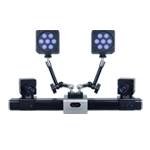
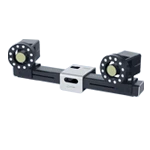
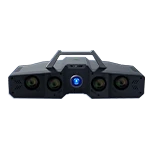
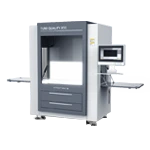
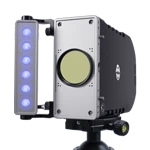
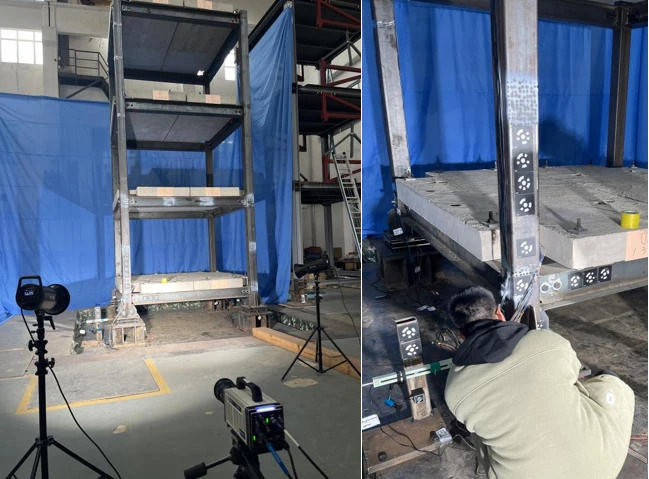
This project involves simulating seismic effects on a large-scale structure (with a 3m base and a height of approximately 7m) using a six-degree-of-freedom shake table. The XTOP3D XTDIC-SPARK 3D high-speed measurement system is employed, utilizing high-speed Digital Image Correlation (DIC) technology to achieve high-precision, non-contact dynamic capture of displacement fields. Contact displacement sensors are installed at the base to compare results against the DIC measurements, thereby validating the reliability of the high-speed DIC measurement technique.
Test Objectives
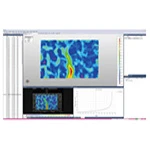
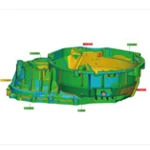
Full-field measurement: Obtain 3D displacement and strain fields for critical regions of the model (e.g., the support base).
Dynamic characteristics: Identify operational mode shapes and deformation patterns of the structure during destructive vibration.
Reliability verification: Cross-validate results against contact-type displacement sensors to quantify the accuracy of high-speed DIC measurements and establish reliability standards.
Comparison: Traditional Displacement Sensors vs. High-Speed DIC Technology
Challenge: Bottlenecks in displacement measurement for large-scale structural shake-table tests
When conducting shake-table tests on large-scale models, traditional contact-based displacement measurement methods (such as draw-wire displacement sensors and LVDTs) exhibit significant limitations:

Testing Process and Specific Steps
Key Technical Implementation Points and Procedures
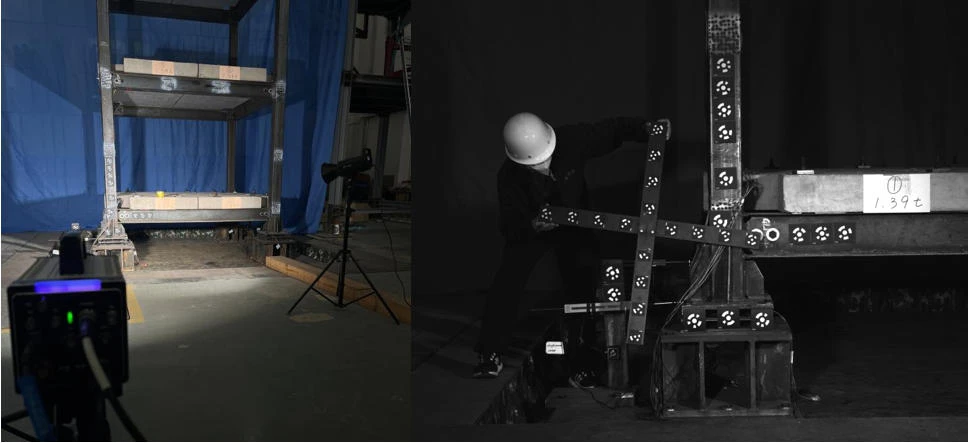
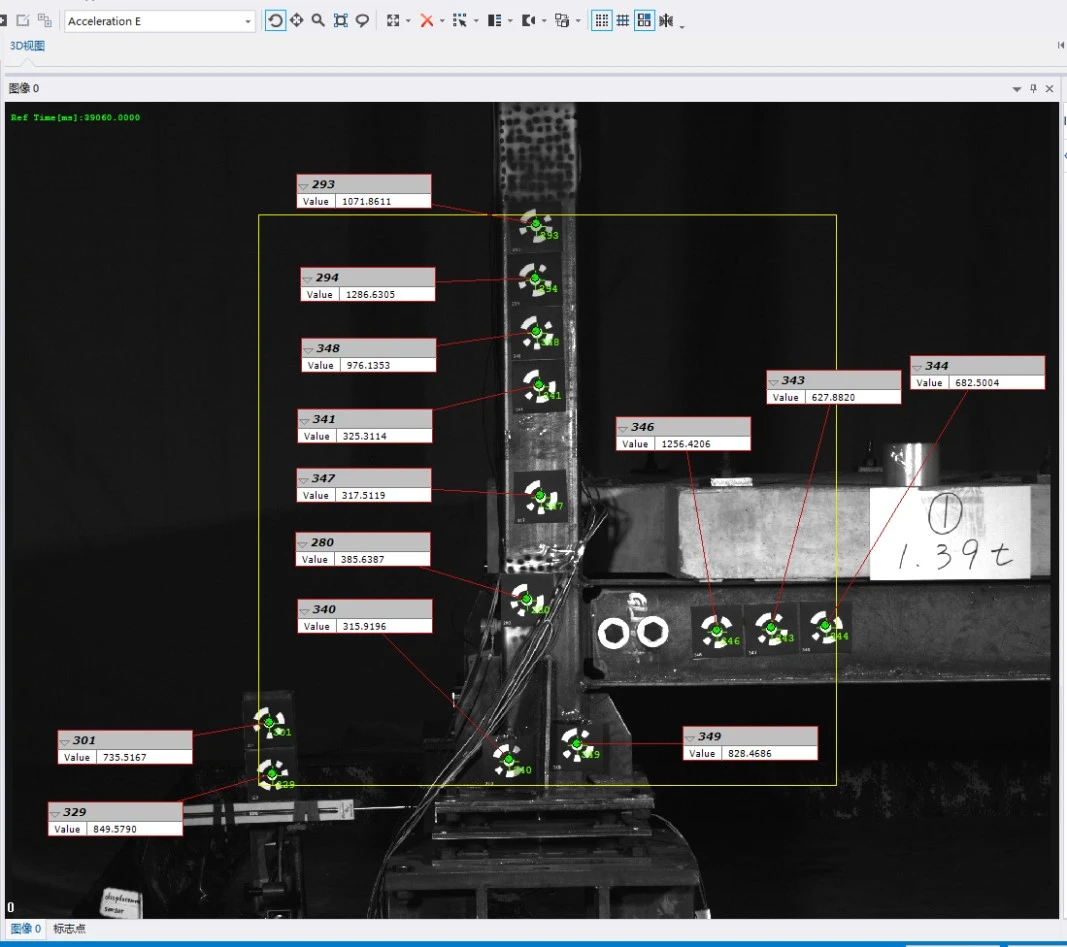
Placement of Coded Markers: Coded markers are arranged on the support frame of the test model to facilitate system recognition and precise spatial coordinate localization.
Dual High-Speed Camera Setup: High-speed cameras are positioned directly in front of the shaking table to ensure full coverage of the test model and the capability to capture high-frequency vibrations.
Synchronized Triggering: Precise time-domain signal synchronization is established among the DIC system, the shaking table control system, and the contact-type displacement sensing system to ensure a consistent data timeline.
High-Speed Dynamic Imaging: The shaking table simulates seismic vibration based on preset earthquake waves. During the test, the high-speed cameras continuously capture high-speed image sequences of the model's surface.
Test Results of the High-Speed DIC Measurement System
To verify the reliability of the high-speed DIC measurement technology, several key locations—including the base, main beam, and crossbeam—were selected. A detailed comparison was then conducted between the displacement-time history data of key points extracted via high-speed DIC and the measurements obtained from LVDTs installed at the same locations.
Comparison metrics:
-
Data curve alignment (including peak values, phase, and waveform characteristics).
-
Absolute difference and relative error of peak critical displacement values.
-
Correlation analysis (Pearson correlation coefficient, etc.).
Highly consistent time-history curves: The displacement time-history curves measured via high-speed DIC coded points exhibit a very high degree of synchronization and similarity with the corresponding LVDT curves in terms of waveform and phase (see the typical curve plots below).
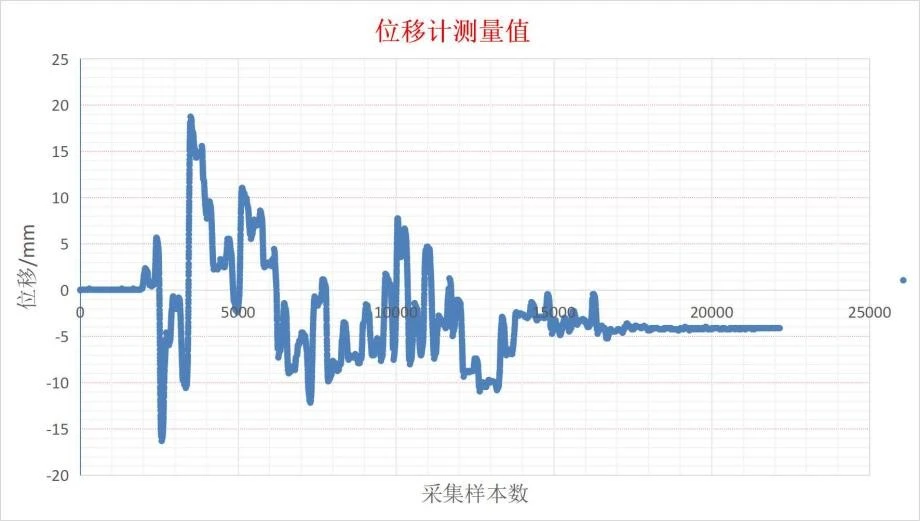
Displacement gauge reading
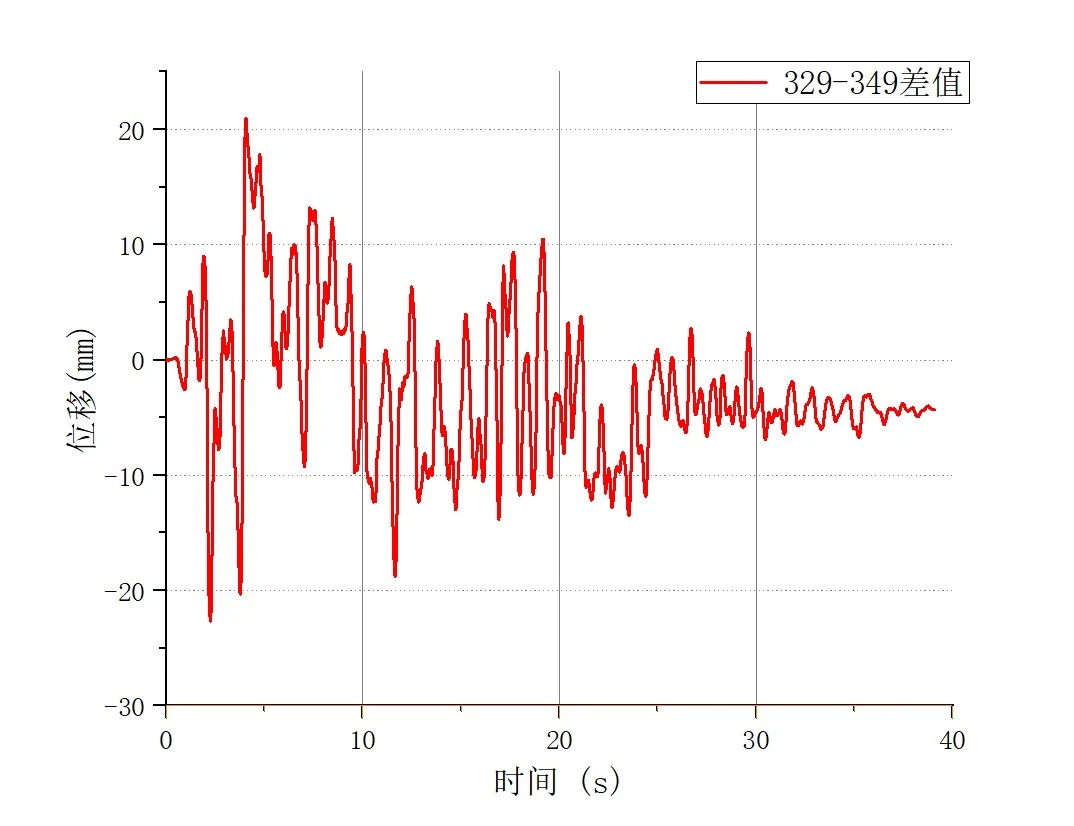
High-speed DIC measurement system readings – (329–349) difference
Value of Shaking Table Tests
-
Shaking table tests evaluate the seismic performance, dynamic stability, and failure modes of scaled or full-scale structural models by simulating the application of real-world loads, such as seismic waves.
-
It directly reflects the nonlinear behavior of the structure under dynamic loads, compensating for the limitations of numerical simulations (such as finite element analysis).
-
To verify seismic design and the reliability of novel structural systems, predict the extent of structural damage, and provide a basis for structural reinforcement and repair.
-
High-speed DIC technology captures comprehensive 3D spatial dynamic information, solving the core challenge of full-field displacement measurement for large, complex structures undergoing intense vibration.