Research Background and Objectives
In prefabricated steel structure buildings, the connection performance of beam-column joints is critical to the overall structural safety and seismic resilience. While steel-tube-confined concrete joints offer advantages such as high load-bearing capacity and good ductility, there remains a lack of precise observation methods to investigate their local deformation mechanisms, strain distribution patterns, and damage accumulation processes under complex loading conditions.
Digital Image Correlation (DIC) technology, an advanced non-contact, full-field deformation measurement method, has been widely adopted in recent years for structural testing in civil engineering. Against the backdrop of seismic performance tests on prefabricated steel-tube-confined concrete beam-column joints, this paper presents typical applications of XTOP3D DIC technology, including strain field analysis in the joint core region, tracking of crack initiation and propagation, and identification of failure modes. The study demonstrates that DIC technology effectively overcomes the limitations of traditional contact-based measurement methods, providing experimental data to support the analysis of mechanical behavior and the design optimization of prefabricated joints.
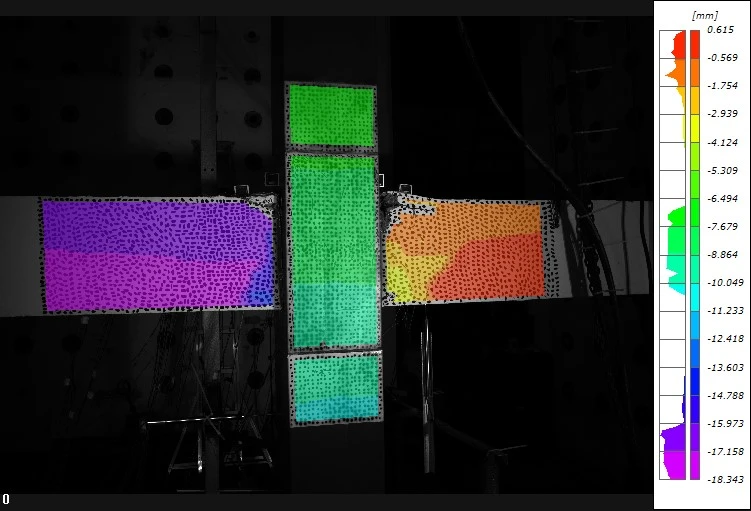
Key Challenges in Monitoring Beam-Column Joints
Prefabricated steel-tube-confined concrete beam-column joints typically utilize connectors such as end plates, bolts, and flanges to facilitate rapid assembly. However, the structural behavior, failure modes, and failure mechanisms of these joints under seismic action require further in-depth study.
▶ For prefabricated joints subjected to cyclic loading, it is difficult to quantify the local buckling behavior of the steel tube at the column end.
▶ Traditional methods fail to capture the correlation between the evolution of three-dimensional strain and the failure modes in the core zone;
▶ A node hysteresis model that considers damage accumulation needs to be established to guide engineering applications.
DIC Technical Solutions
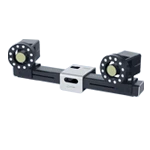
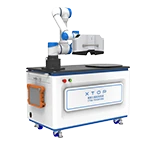
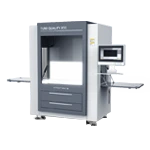
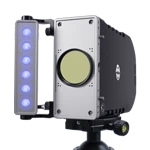
The XTOP3D XTDIC 3D full-field strain measurement system enables the monitoring of surface strains at the column ends of specimens and the observation of failure modes. It facilitates the analysis of seismic performance indicators—such as hysteretic curves, ductility, and energy dissipation capacity—at critical joints. This supports the development of modified damage models tailored to prefabricated joints, providing both theoretical and experimental backing for the engineering application of prefabricated frame structures.
▶DIC technology enables real-time monitoring of the 3D strain field on the column end surface and correlates it with failure modes.
▶ Seismic performance indicators—such as hysteretic curves, ductility, and energy dissipation capacity—are extracted based on full-field displacement data.
▶ A modified damage model is developed to provide a basis for the design of prefabricated frames.
Specific Applications of DIC Technology
Beam-column specimen: A prefabricated beam-column joint specimen consisting of concrete confined by a steel tube. The core region utilizes high-strength concrete confined by a steel tube, while the beam and column are connected via annular end plates secured with high-strength bolts. A high-contrast, fine, and stable random speckle pattern is applied to the surface of the specimen.
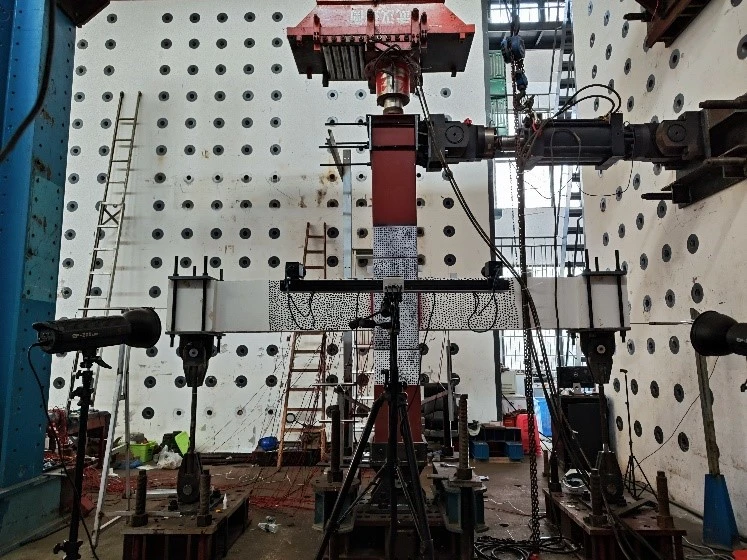
Loading method: Quasi-static, low-cycle, stepwise reversed cyclic loading is employed to simulate seismic action. The loading apparatus is equipped with force and displacement sensors.
DIC Critical Monitoring Zones: The DIC system's image acquisition frame rate is strictly synchronized with the displacement and force signals from the loading equipment. The DIC system covers a measurement area of 4 m × 3 m, focusing on the core zone of the joint, the steel tube walls at the column ends (buckling-prone areas), the ring plate connection zones, and the plastic hinge regions at the beam ends.
Key Applications and Achievements of DIC Technology
1. Visualization of full-field deformation modes
The XTDIC 3D full-field strain measurement system clearly captures global deformation patterns—such as beam bending and shear deformation in the core zone—as well as local relative displacements, such as micro-slip between the ring plate and the steel tube/concrete and deformation near bolt holes, under various load levels.
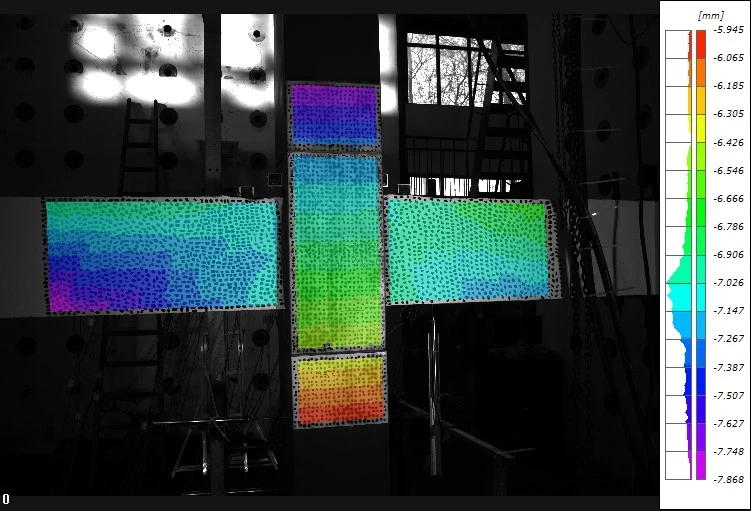
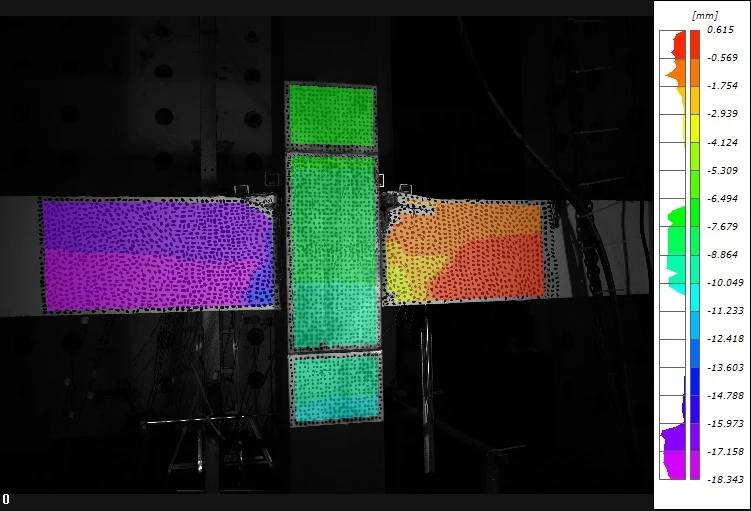
Transverse displacement field of beam-column joints
Displacement analysis of key points at the top:
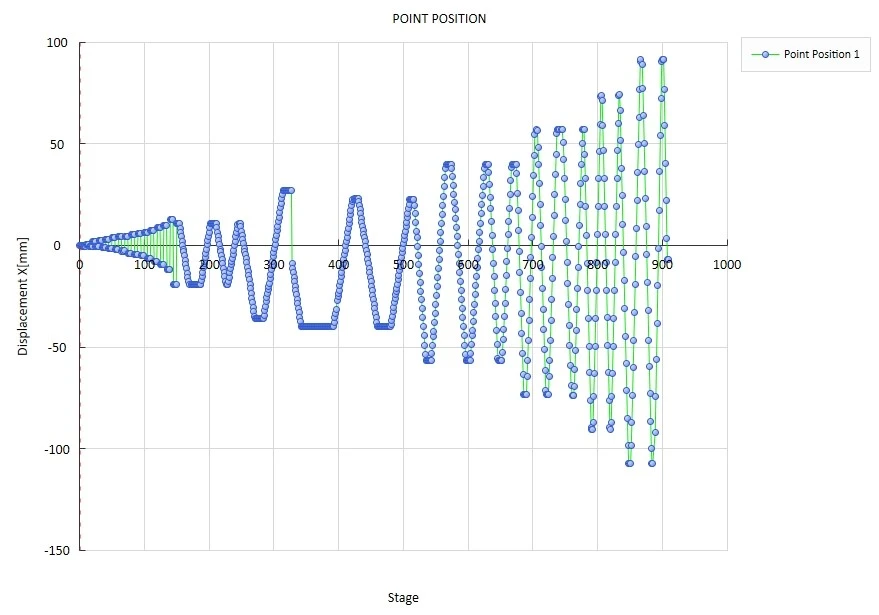
Extract the displacement of the top corner point of the beam end and plot the "vertex lateral displacement vs. load" curve. The vertex displacement hysteresis curve is obtained directly from DIC data; this key displacement parameter is closely related to changes in beam-column stiffness.
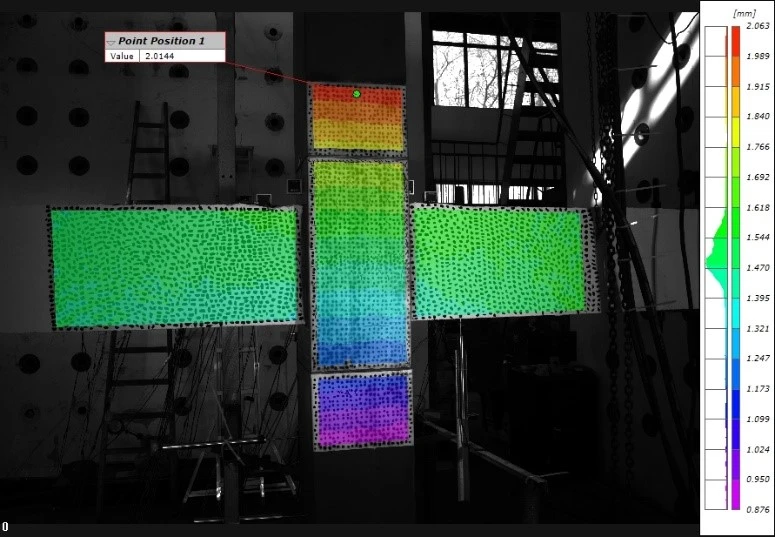
Analysis of Key Point Displacements at Beam-Column Joints
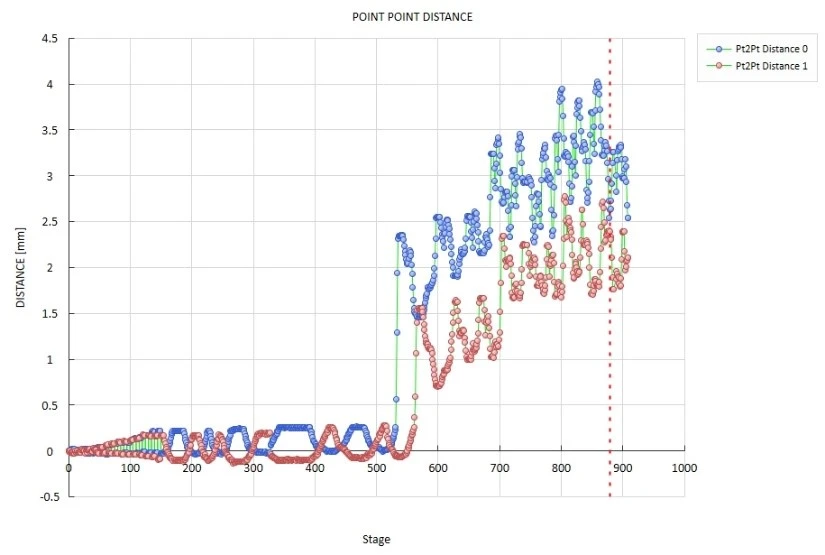
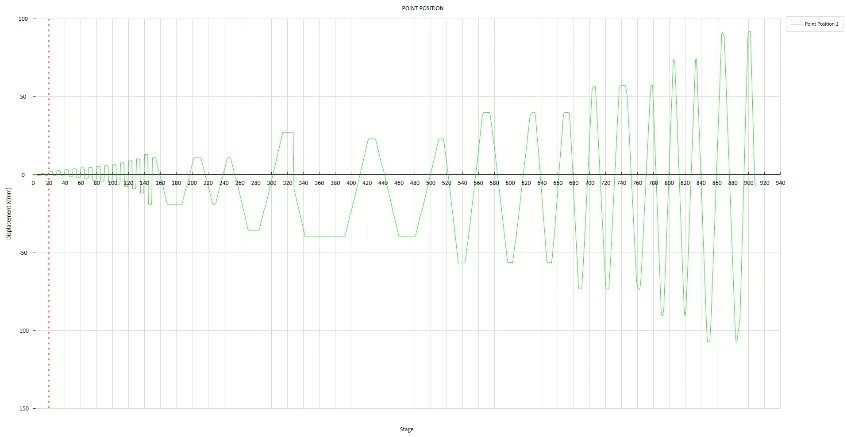
Lateral displacement curve of the beam-column top
Significance: It intuitively demonstrates the gradual transition of nodal displacement from elastic uniform distribution to plastic localization, revealing the performance of the prefabricated connection under cyclic loading.
2. Strain field mapping and stress concentration identification
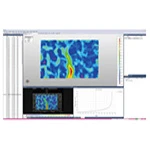
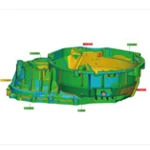
DIC technology analyzes the full-field in-plane strain distribution and principal strains/directions in critical regions of the joint (particularly the edges of the annular plate, the corners of the steel tube, and the concrete surface of the core zone), enabling precise identification of the locations of maximum tensile and compressive strains and their evolution with the applied load.
Key findings: Significant strain concentration occurs near the interface between the steel tube and the concrete it confines—specifically at the root of the weld connecting the annular plate to the steel tube—identifying this as a potential site for damage initiation. Under shear action, the concrete in the core region exhibits distinct diagonal bands of principal compressive strain.
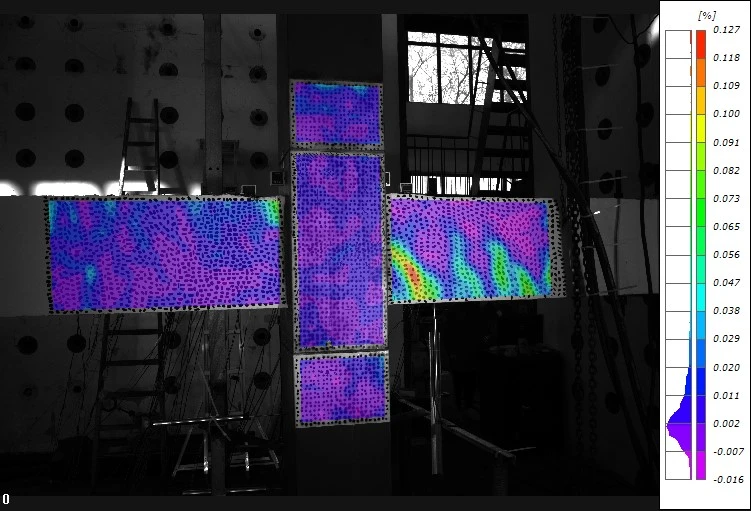
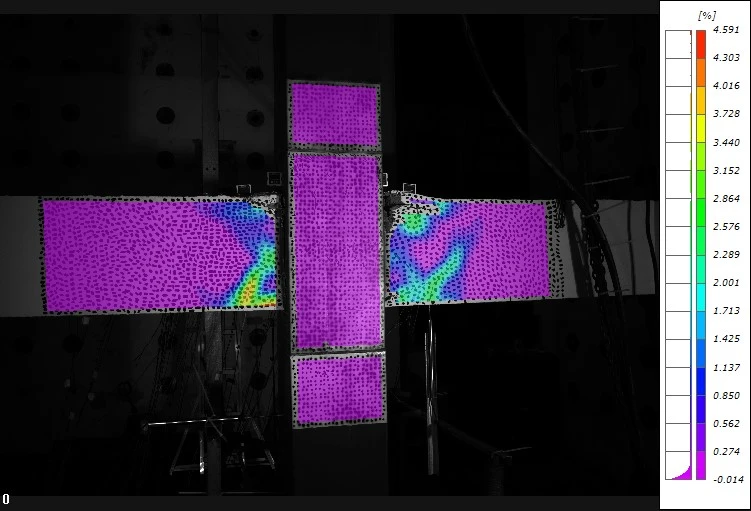
Strain field of concrete beam-column joints
Value: It provides direct and detailed experimental evidence for assessing the stress state of nodes and identifying weak points, offering a wealth of information far exceeding that of traditional point-based measurements.
3. Monitoring of the entire process of crack initiation, propagation, and damage evolution.
Results: By analyzing displacement field discontinuities and localized high-strain zones, DIC technology precisely captures the initiation location, timing, propagation path, and width variation of micro-cracks on the concrete surface, while monitoring the onset and progression of local buckling in the steel tube.
Under cyclic loading, micro-cracks propagate along the joint, accompanied by the appearance of diagonal shear micro-cracks in the core concrete; at large displacement angles, cracks in the core concrete coalesce to form a distinct diagonal shear crack band, and strain surges in localized areas of the ring plate, leading to the final failure mode (crushing of core concrete, and tearing or buckling of the ring plate).
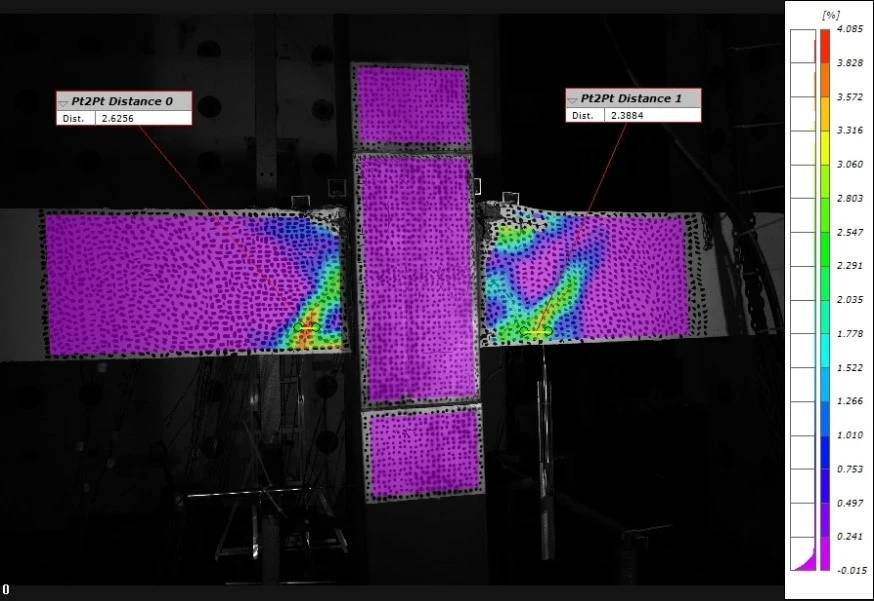
Sequence of images showing crack initiation and propagation identified by DIC.
Crack width curve from DIC analysis
Significance: It dynamically and quantitatively reveals the damage accumulation mechanisms and failure paths of joints under cyclic loading, providing a foundation for developing more accurate numerical models and damage assessment methods.
4. Quantitative Evaluation of Node Performance
By utilizing full-field DIC data, key performance parameters—such as shear deformation in the joint core, beam-end rotation, and plastic hinge length—can be calculated to evaluate joint stiffness degradation, energy dissipation capacity, and ductility coefficients.
Value: It provides more comprehensive and reliable experimental data to support the assessment of the seismic performance of joints.
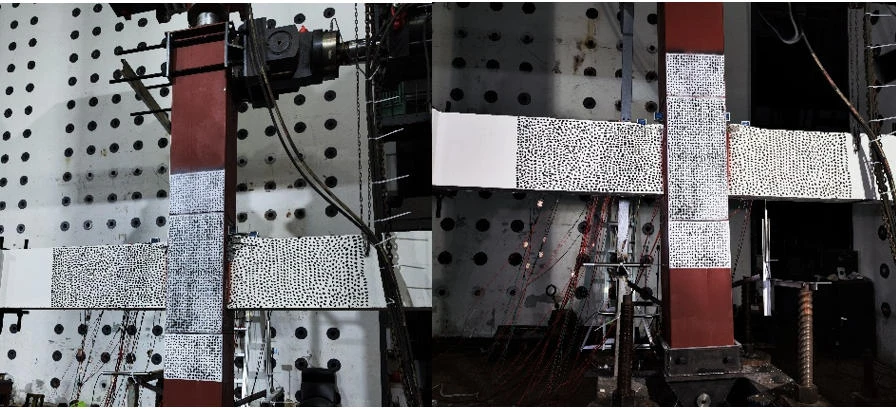
Node cyclic loading failure conditions
Research Conclusions and the Value of DIC
This case study demonstrates the significant contribution of Digital Image Correlation (DIC) technology to deformation monitoring and failure mode analysis in components such as large-scale prefabricated joints. DIC offers distinct advantages in terms of full-field measurement, data richness, and the validation of numerical models. Unlike point sensors, DIC provides complete displacement and strain fields, enabling the precise identification of stress concentrations and damage zones—such as areas surrounding joints or the location and propagation of cracks. By extracting displacement curves at key points, researchers can analyze seismic performance indicators—including hysteretic behavior, ductility, and energy dissipation capacity—with unparalleled detail.
However, DIC measurement is not without challenges. Measurement quality depends heavily on experimental conditions, particularly calibration, lighting, and the quality of the speckle pattern. Inadequate preparation can introduce errors, especially under high strain rates. Furthermore, cyclic loading induces significant cracking and damage that are difficult to capture dynamically using contact-based methods; this highlights the reliability and broad utility of DIC.
Compared to other measurement techniques, DIC provides a comprehensive view of the phenomena under study, whereas strain gauges offer only discrete data points that are often insufficient for validating complex 3D models. Unlike accelerometers, which are limited to measuring acceleration, DIC directly captures full-field strain. This allows for the quantitative assessment of the structural behavior of prefabricated frames, providing an empirical basis for evaluating seismic performance and suitability.