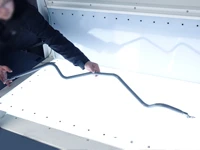
1. Core Application Value of DIC Technology
The three-point bending test for concrete is a key method for evaluating flexural strength, fracture toughness, and damage evolution (adapted from the GB/T 232-2010 standard for metal bending tests).
"Non-contact, full-field deformation measurement has revolutionized the experimental paradigm of fracture mechanics; its contribution is comparable to that of electrical measurement methods to 20th-century materials testing."
— M.A. Sutton, pioneer of DIC and author of *Image Correlation for Shape, Motion and Deformation Measurements* [1]
DIC technology overcomes the limitations of traditional methods through non-contact, full-field measurement:
Visualization of crack initiation and propagation: Precisely captures the location of initial micro-cracks (typically at the center of the bottom surface) and multi-directional propagation paths, with a localization accuracy of 0.01 mm (whereas traditional strain gauges can only monitor pre-set points) [1].
Dynamic reconstruction of strain fields: Generates real-time strain distribution maps, revealing neutral axis shifts and strain gradients within the compression and tension zones.
Quantitative analysis of fracture parameters: Derives Crack Mouth Opening Displacement (CMOD) and Crack Tip Opening Displacement (CTOD) from displacement fields, enabling the direct calculation of fracture energy and stress intensity factors [2].
2. Evolution of DIC Technology and Disciplinary Resonance
The essence of failure is that the energy release path is pre-marked by the strain gradient field.
— Pijaudier-Cabot, Journal of Mechanics and Physics of Solids, 2022[11]
1. DIC technology drives the development of fracture mechanics
Traditional methods for concrete three-point bending tests yield only mid-span displacement-load curves, failing to capture internal damage evolution and relying on predetermined sensor locations.
DIC technology enables full-field displacement analysis, establishing a link between strain localization and macroscopic fracture [3]. When combined with X-ray computed tomography, 3D DIC technology correlates strain localization with macroscopic fracture [3], facilitates the reconstruction of 3D micro-crack networks [5], and advances the development of standards for intelligent fracture criteria [7].
2、Disciplinary needs drive technological innovation.
The multi-scale nature of concrete (specifically the aggregate-mortar interface) necessitates the evolution of DIC technology toward multi-scale, coordinated measurement:
Macro-micro cross-scale analysis: Utilizing a dual-lens synchronous system (a 50mm lens for the macro-scale field and a microscopic lens for the aggregate interface) enables the observation of strain transitions ranging from millimeter-scale full-field deformation to micrometer-scale localized jumps [4].
Adaptation to dynamic loading: Concrete instability and fracture often occur on a millisecond timescale; pairing DIC with high-speed cameras allows for the successful capture of the transient process of rapid crack propagation.
"To understand concrete fracture, one must simultaneously observe millimeter-scale cracks and micrometer-scale aggregate-paste debonding."
— Xu Minglong, *Cement and Concrete Research*, 2023 [4]
"Over the next decade, AI will transform DIC from a mere 'data recorder' into a 'structural diagnostic brain'."
— Liu Qian, *Automation in Construction*, 2025 [10]
3. Engineering Solutions—Case Study of Concrete Three-Point Bending
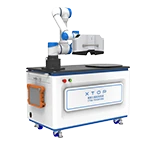
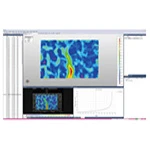
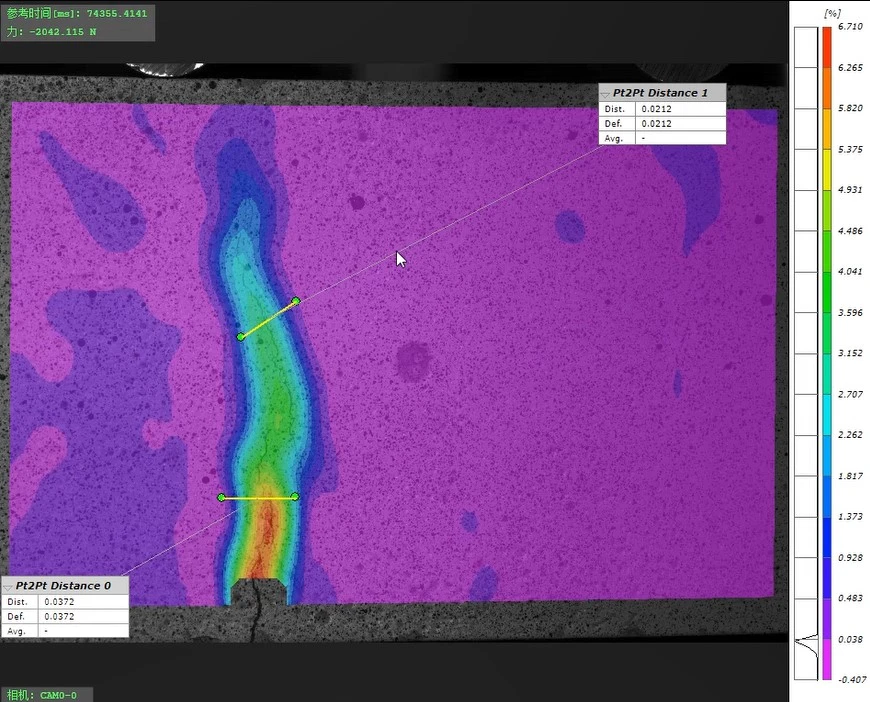
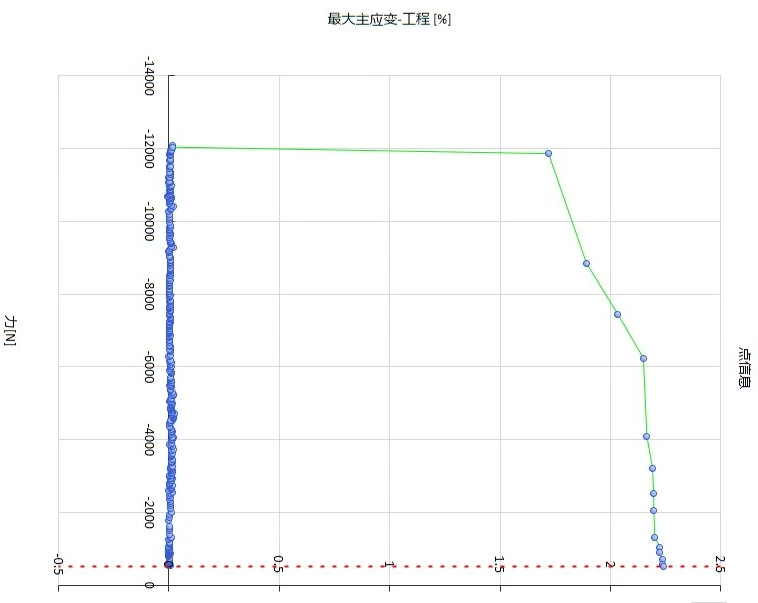
The XTOP3D XTDIC 3D full-field strain measurement system was employed to analyze surface strain and strain field data during the three-point bending loading of concrete specimens. By generating crack propagation length-load curves and utilizing dynamic sequences of full-field strain maps, the staged evolution pattern of the crack—comprising the elastic stage, stable propagation, and unstable fracture—was effectively validated.
Three-point bending test case of concrete
Specimen Preparation: Concrete beam specimens with high-contrast speckle patterns sprayed onto the surface.
Equipment Configuration:
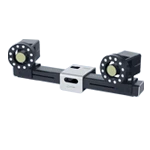
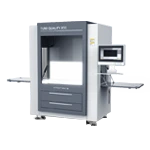
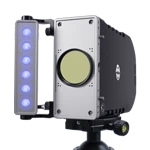
XTOP3D XTDIC 3D full-field strain measurement system, equipped with a DIC-1200W sensor head and 50mm fixed-focal-length lenses. The DIC system is synchronized with the testing machine via TTL signals to ensure strict temporal alignment of load, displacement, and image data.
Analysis of Key Achievements
Displacement field evolution:
Elastic stage: The vertical displacement field exhibits a symmetric parabolic distribution (with maximum displacement at the loading point).
Crack propagation stage: Zones of steep displacement gradients emerge, indicating the path of the main crack.
Instability stage: A sudden change in displacement vector orientation occurs at the moment of specimen splitting, allowing for the quantification of displacement across the crack faces.
Failure zone identification via strain energy density mapping:
High strain energy concentration zones are identified using strain contour maps, enabling the prediction of the fracture location at 90–95% of the failure load [6].
Crack initiation and propagation in concrete specimens
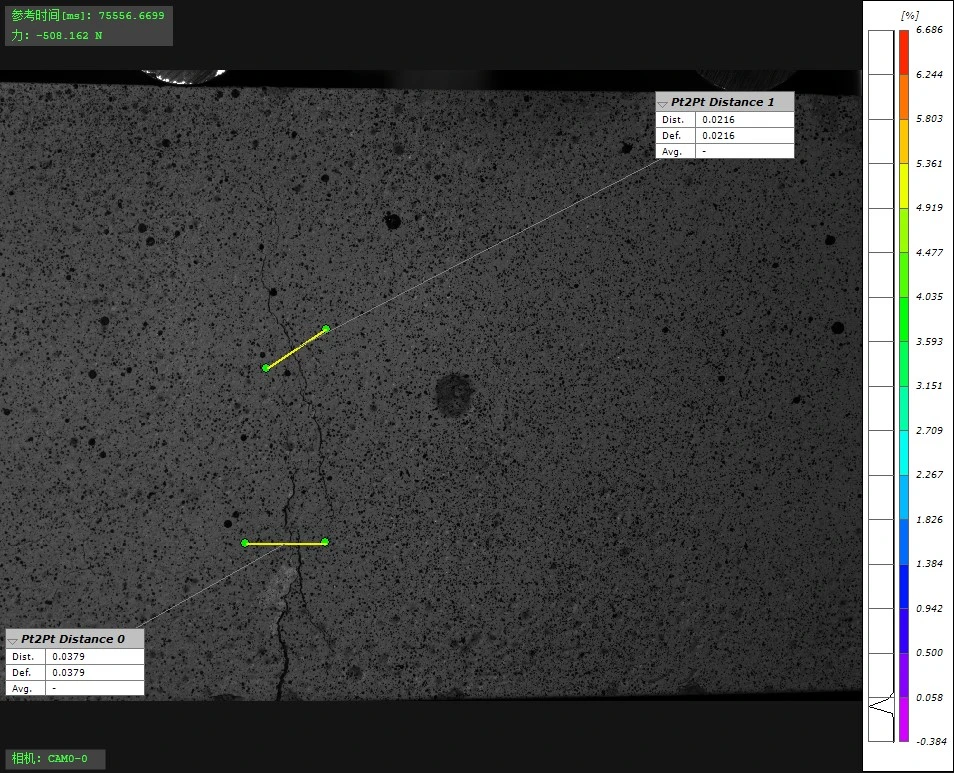
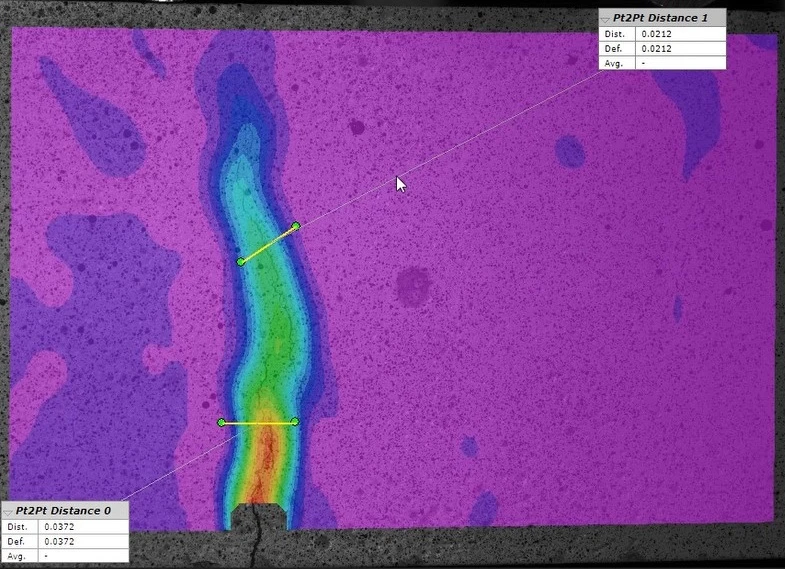
Strain data with load signals for concrete specimens
4. Development Trends and Application Prospects of DIC Technology
Technological convergence and innovation
Multiphysics coupling: Integrating infrared thermography to monitor frictional heating effects at cracks and correlating strain fields with thermodynamic dissipation [8]
Deep learning enhancement: Applying Transformer models to predict crack propagation paths (mean squared error < 5%) [9]
Real-time cloud-based analysis: Developing DIC edge computing modules to enable on-site, real-time quality diagnostics.
With its full-field, dynamic, and visual measurement capabilities, DIC technology has become the gold standard for analyzing three-point bending fracture in concrete. It addresses critical challenges—such as capturing dynamic crack behavior and correlating multi-scale damage—thereby driving the transition of fracture mechanics from phenomenological to mechanistic models and enabling full-field strain evolution analysis (load-displacement). Furthermore, by integrating AI algorithms with a cloud-edge collaborative architecture, it reshapes the paradigm of civil engineering inspection and empowers the development of intelligent infrastructure.
References
[1] Sutton M A,et al. Image Correlation for Shape, Motion and Deformation Measurements. Springer, 2009.
[2] Lecompte D, et al. DIC-based fracture criteria for concrete. Eng Fract Mech, 2015, 141: 1-15.
[3]Li et al. Evolution of the fracture process zone in concrete based on DIC. Engineering Mechanics, 2022, 39(4): 112-120.
[4] Xu M L,et al. Multiscale DIC for concrete interfacial transition zone. Cem Concr Res, 2023, 169: 107189.
[5] Smith J, et al. 3D fracture network reconstruction with X-ray tomography. Acta Mater, 2021, 215: 117053.
[6] Yu Q,et al. Energy-based failure prediction of concrete. Constr Build Mater, 2024,411: 134444.
[7] Chenet al.Deep Crack U-Net for damage segmentation.Autom Constr,2025,142: 104589.
[8] Frost&Sullivan. Structural Health Monitoring Market Outlook.2025.
[9] MarketsandMarkets™.DIC in Civil Engineering,2024.
[10]Liu Qian,《Automation in Construction》 2025
[11]Pijaudier-Cabot, Journal of Mechanics and Physics of Solids, 2022