When using DIC (Digital Image Correlation) technology for modal analysis, accurately identifying modal parameters (such as natural frequencies, damping ratios, and mode shapes) requires combining multiple stages of data acquisition, processing, and analysis. The following are key methods:
High-quality data collection
Speckle pattern preparation: A uniform and random speckle pattern is prepared on the surface of the structure to be tested to ensure that the speckle can clearly reflect the structural deformation and avoid excessive density or sparseness.
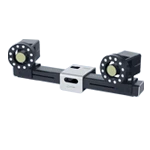
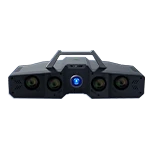
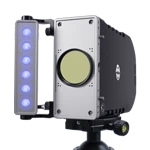
Camera settings: Use a high-resolution, high-frame-rate camera, selecting an appropriate frame rate based on the structural vibration frequency to ensure detailed vibration capture. If 3D measurement is required, employ a binocular stereo vision system and accurately calibrate the camera parameters.
Environmental control: Collect data in stable lighting and free from strong interference as much as possible to reduce the impact of lighting changes and vibration interference on image quality.
Precise displacement field calculation
Sub-region segmentation and matching: The reference image is divided into multiple sub-regions, and the best matching position is searched in the target image through algorithms such as normalized cross-correlation, and the sub-pixel displacement is calculated.
Error correction: Correct camera calibration errors, lens distortion, etc., and use gradient method, surface fitting method, etc. to improve the accuracy of displacement calculation and reduce the influence of noise.
Modal parameter identification method
Frequency domain analysis:
Peak Picking Method (PP): Perform Fourier transform on the displacement time history, directly pick the peak frequency in the spectrum as the natural frequency, and estimate the damping ratio using the half-power bandwidth method.
Enhanced Frequency Domain Decomposition (EFDD): This method performs singular value decomposition on the frequency response function matrix to extract modal parameters. It is suitable for multi-mode and low signal-to-noise ratio scenarios.
Least Squares Complex Frequency Domain Method (LSCF): By fitting the frequency response function curve, the modal parameters are solved. It has high accuracy but requires a large amount of computation.
Time-domain analysis:
Natural excitation technique - Ibrahim time-domain method (NExT-ITD): It uses the cross-correlation function of the structural response under environmental excitation to replace the impulse response function, constructs the response matrix, and identifies the modal parameters through eigenvalue decomposition. It has strong noise resistance and is suitable for non-stationary excitation.
The random subspace method constructs a state-space model based on time-domain data and extracts modal parameters through singular value decomposition. It has high computational accuracy but high computational complexity.
Multi-point fusion and verification
By leveraging the full-field measurement advantages of DIC technology and combining displacement data from multiple measurement points, the consistency of modal parameters is verified through the modal superposition principle or modal criteria, thereby improving the reliability of identification.
The accuracy is verified by comparing the identification results with finite element simulation results or traditional sensor measurement results.
Using the above methods, DIC technology can accurately identify the modal parameters of a structure under non-contact, full-field measurement conditions, and is suitable for complex structures, high-temperature and high-pressure environments, or scenarios where traditional sensors are difficult to deploy.