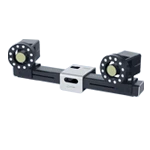
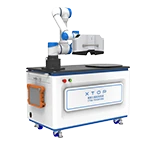
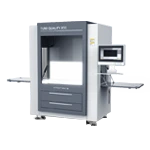
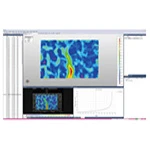
In the aerospace field, every small improvement in material properties translates to longer ranges, greater payloads, and enhanced safety. The key to achieving these breakthroughs often lies in understanding the behavioral patterns of materials and structures under extreme high-temperature environments. The DIC high-temperature strain measurement system is the core key to unlocking the mechanical performance testing of special materials under high-temperature conditions, providing a non-contact testing solution for the research and development and verification of next-generation aerospace vehicles.
High Temperature: The Ultimate Test of Aerospace Vehicle Performance
From the scorching hot outer shell of supersonic aircraft due to aerodynamic heating, to the thousands of degrees of flame surging in the combustion chamber of rocket engines, and to the extreme temperatures that aero-engine turbine blades endure far exceeding the melting point of metals, high temperatures are a harsh normal that aerospace vehicles must face.
The strength, stiffness, deformation, fatigue, creep, and interfacial behavior of materials in these environments directly determine the performance limits, service life, and safety of aircraft. Traditional testing methods are inadequate for the demands of high-temperature, non-contact, and full-field measurement.
DIC High-Temperature Strain Measurement System: Precisely Capturing the "Pulse" of High Temperatures
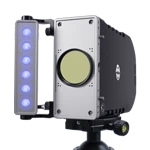
The DIC high-temperature strain measurement system overcomes numerous challenges such as strong thermal radiation, speckle failure, and thermal drift, providing revolutionary testing capabilities for high-temperature components in aerospace applications.
Turbine Blades: Precise Control of Thermo-Mechanical Coupling Deformation
Challenge: Under the combined effects of high-speed rotation, high-temperature combustion gas scouring, and complex cooling structures, blades bear extremely complex non-uniform thermo-mechanical loads, and their minute deformations directly affect aerodynamic efficiency, vibration characteristics, and lifespan.
DIC High Temperature Strain Measurement Solution: On a high temperature gas wind tunnel or thermo-mechanical test bench that simulates real working conditions, the DIC system can non-contactly measure the three-dimensional deformation and strain distribution of the blade surface under steady-state and transient conditions (such as start-up and shutdown).
Key data and applications:
Precise measurement of the change in blade tip clearance at high temperatures (with an accuracy down to the micrometer level) provides a basis for the design of active clearance control (Journal of Turbomachinery, 2023).
We captured the full-field strain of thermal barrier coatings (TBCs) under thermal cycling loads, revealing the evolution of surface cracking (transverse cracks) and interfacial delamination (edge strain concentration) in the coating. Data showed that after 100 thermal cycles at 1100°C, the strain value in the edge strain concentration region of a certain type of blade TBC reached more than twice that of the substrate material (Materials Science and Engineering: A, 2023).
Verify the impact of cooling hole layout on blade temperature field and thermal deformation, and optimize cooling efficiency.
Combustion chamber and nozzle: Guardians of thermal deformation and structural integrity
Challenges: Combustion chamber walls and nozzle expansion sections undergo thermal deformation and creep under the impact of high-temperature and high-pressure combustion gases, cooling structures may fail, and connection points are subjected to enormous thermal stress.
DIC High Temperature Strain Measurement Solution: In a high temperature and high pressure combustion test bench, the DIC system can measure the bulging deformation of the panel under thermal load, the local strain concentration in the weld area, and the deformation compatibility of the cooling structure (such as the sweating cooling panel).
Key data and applications:
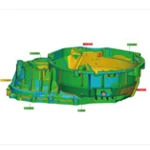
The thermal deformation field of a regenerative cooling thrust chamber panel was measured under simulated ignition conditions, with the maximum out-of-plane deformation reaching several millimeters, providing high-precision boundary conditions for thermal-structural coupling analysis (AIAA Journal, 2023).
Monitoring the relaxation of preload in high-temperature bolted connections under long-term thermal loads, and inverting the bolt stress state through micro-deformation of the connection area.
High-Temperature Composite Materials and Lightweight Structures: Powerful Tools for Performance Verification
Challenge: The mechanical behavior and failure modes (especially failures under complex stress states) of ceramic matrix composites (CMCs) such as C/SiC and C/C, as well as lightweight materials such as novel high-temperature alloys and titanium-aluminum alloys, need to be accurately characterized at high temperatures.
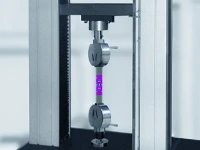
DIC Solution: Provides full-field strain data for materials in high-temperature tensile, compression, bending, shear, fatigue, and creep tests, revealing the laws governing non-uniform deformation, damage initiation, and propagation.
Key data and applications:
Notched tensile tests were conducted on C/SiC composite specimens at 1400°C. The DIC clearly captured the tortuous crack propagation path and crack tip process zone at the fiber bundle/matrix interface, and the measured fracture toughness value was superior to that of the traditional extensometer method (Composites Part B: Engineering, 2023).
Quantify the residual strain accumulation and interfacial slip behavior of a novel high-temperature titanium-aluminum laminate under thermo-mechanical cyclic loading.
From Data to Design: Driving a Leap in Performance
The massive amounts of full-field data provided by the DIC high-temperature strain measurement system are valuable in deeply driving the design and optimization of aerospace vehicles.
Simulation model "touchstone": High-fidelity full-field deformation/strain data is the most powerful evidence for verifying and correcting complex thermo-mechanical-fluid coupled CAE models, significantly improving the confidence of virtual simulation.
Failure Mechanism Decoder: Intuitively reveals the failure origin and development process of high-temperature components under real or simulated operating conditions, providing direct guidance for design improvements (such as structural optimization, material selection, and coating process improvement).
A boost to life prediction: Based on accurately measured high-temperature creep and fatigue deformation data, a more reliable life prediction model is established.
Process optimization "compass": Evaluate the residual stress and deformation compatibility of high-temperature joints or components formed by processes such as welding, brazing, and additive manufacturing.
In the aerospace field's continuous pursuit of pushing the limits of speed, efficiency, and reliability, high-temperature environments are a challenge that must be overcome. The DIC high-temperature strain measurement system, with its unique non-contact, high-precision, and full-field capabilities, provides researchers with a visualized solution for deeply understanding the mechanical properties of materials and structures under high-temperature conditions. This empowers optimized design, improved performance, and enhanced safety, laying a solid technological foundation for the next generation of more efficient, reliable, and powerful aerospace vehicles.