Industry pain points and DIC technology advantages
In extreme operating environments such as rocket engines and nuclear fusion reactors, strain data of materials at ultra-high temperatures of 3000°C is a core basis for safety design. Traditional electrical measurement methods fail due to sensor melting, while digital image correlation (DIC) technology achieves three major breakthroughs through non-contact optical measurement:
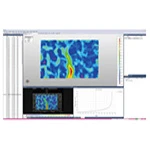
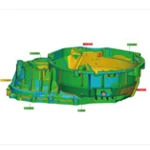
Full-field strain measurement: Captures the micro-strain distribution at 10,000+ measurement points on the material surface (accuracy ±0.05%).
Anti-extreme thermal interference: High-temperature resistant optical system + thermal drift compensation algorithm, stable operation in 3000°C gas.
Dynamic process tracking: High-speed acquisition of crack initiation process under thermal shock at 1000fps.
Key technology breakthrough details
Ultra-high temperature speckle preparation technology
A yttrium-stabilized zirconia (YSZ) coating applied by plasma spraying exhibits a speckle reflectance attenuation of <5% in an oxidizing environment at 3000°C.
Nanoscale Al₂O₃-MoSi₂ composite speckle pattern, resistant to thermal shock cycles >200.
Multispectral anti-interference system
Dual narrowband filtering (808nm±5nm & 1064nm±10nm) suppresses thermal radiation noise.
Sapphire protective window (8mm thick) blocks 160kW/m² heat flux.
Thermal deformation separation algorithm
Based on real-time temperature field mapping from an infrared thermal imager, compensation is made for apparent strain errors caused by thermal expansion.
Strain measurement uncertainty < 50 με (@1500°C)
Empirical evidence of cutting-edge applications
Solid rocket motor throat liner material: DIC technology can be used to monitor the anisotropic strain of C/C composite materials at 2900°C.
Nuclear fusion device divertor target plate: Digital speckle (DIC) technology can track the thermal fatigue crack propagation rate of tungsten-copper gradient materials.
Hypersonic vehicle thermal protection system: Digital speckle (DIC) technology can quantify the warping deformation of ceramic matrix composites under Mach 7 aerodynamic heating.