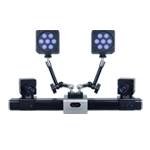
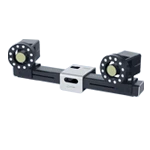
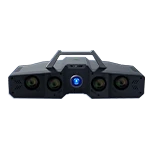
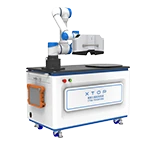
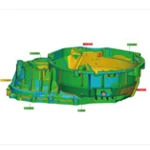
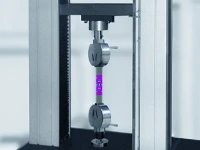
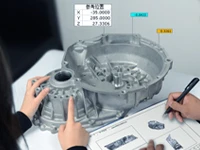
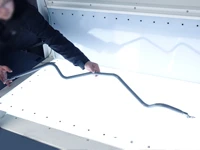
The 3D digital image correlation (DIC) method originated in the field of experimental mechanics and was used to measure displacement and strain fields. With the gradual maturation of measurement methods, 3D-DIC technology has been widely applied in other fields, such as materials, biology, medicine, industrial inspection, and aerospace.
The wide range of applications has established the important position of the 3D-DIC method in the fields of science and engineering. At the same time, it has also put forward new demands on the 3D digital image correlation DIC method, and brought challenges to the research of 3D-DIC technology, especially the requirements of high precision, high computing speed and strong robustness.
When using 3D-DIC digital image correlation technology to measure the three-dimensional deformation of an object's surface, it is necessary to process images captured by two cameras at various times, including steps such as stereo matching and temporal matching, which involves a very large amount of computation.
Current acceleration of 3D digital image correlation (DIC) and its computational speed are insufficient to meet the requirements for real-time measurement of 3D deformation, and most computational efficiency optimizations come at the cost of sacrificing some measurement accuracy. GPU-accelerated 3D digital image correlation methods can achieve high-precision, real-time 3D digital image correlation deformation measurement.
For 3D digital image correlation (DIC) deformation measurement, which suffers from slow computation speed and low real-time performance, the 3D-DIC deformation measurement algorithm needs to be optimized without sacrificing measurement accuracy. Then, the 3D deformation measurement algorithm is parallelized and a GPU-accelerated real-time 3D-DIC deformation measurement program is developed.
When the number of POIs (Points of Interest) approaches 10,000, the program's processing speed reaches 34ms per frame (approximately 29.4 fps), meeting the requirements for real-time processing.
3D-DIC High-Precision, Real-Time Measurement Challenges
The 3D digital image correlation (DIC) method includes steps such as camera calibration, stereo matching, 3D reconstruction, and 3D displacement calculation. It involves a large amount of computation, making the realization of a real-time 3D digital image correlation measurement system an urgent task.
The stereo matching task is the most critical part of the 3D-DIC method. Mainstream 2D-DIC algorithms are sub-pixel iterative algorithms, requiring a relatively accurate initial value to ensure convergence to the correct result.
Path-dependent initial value estimation methods suffer from problems such as error accumulation and propagation, and difficulty in parallelization; path-independent initial value estimation methods struggle to handle scenarios with large deformations or rotations; while feature-assisted methods are highly robust, their feature matching steps are extremely time-consuming. Therefore, initial value estimation methods for stereo matching in 3D-DIC still require improvement.
GPU Parallel Acceleration Solutions
A robust 3D-DIC stereo matching method based on epipolar constraints is proposed, employing a GPU-based parallel acceleration method for 3D digital image correlation.
(1) A stereo matching algorithm based on epipolar constraints. To address the problem of poor robustness, a new stereo matching algorithm based on epipolar constraints is adopted, which provides multiple initial values for the high-precision iterative algorithm.
(2) A detailed parallelization analysis of the IC-GN 2 algorithm in 3D-DIC matching was performed, and then the parallel IC-GN 2 algorithm was implemented on CPU and GPU respectively.
(3) GPU acceleration based on CUDA. The 3D-DIC deformation measurement algorithm was optimized; then a GPU-accelerated 3D-DIC real-time deformation measurement program was developed based on CUDA.
3D-DIC Algorithm Optimization Design
1. 3D-DIC Stereo Matching Algorithm Based on Epipolar Constraints
The epipolar-based stereo matching method provides multiple initial values for each POI, especially when there are large differences in viewpoints or relative rotation between two images, and does not cause problems such as error accumulation and propagation.
2. Image Feature-Based Matching Initial Value Estimation Method
Various image features, such as SIFT, SURF, and ORB, are used to estimate initial values for the DIC matching algorithm. By decoupling the specific feature algorithms, this image feature-based matching initial value estimation method can use any one or more image feature algorithms to provide key points.
SIFT features are highly robust, exhibiting scale invariance, translation invariance, and rotation invariance, and also demonstrate stability against viewpoint changes and noise. SIFT features are used to estimate the initial deformation vector for the Point of Interest (POI), while a stereo matching algorithm based on epipolar constraints is employed for topography measurement.