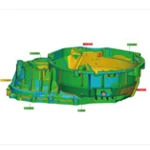
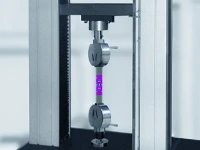
When DIC (Digital Image Correlation) technology is used for vibration measurement, the sources of error and methods for suppression are as follows:
Sources of error:
Systematic error
Sub-region displacement mode assumption error: Traditional DIC assumes that the sub-region deformation is constant strain, but the actual deformation may be more complex, leading to truncation error.
Subpixel reconstruction error: When recovering subpixel speckle images using interpolation methods (such as bilinear or polynomial interpolation), it is impossible to reconstruct them completely accurately, introducing systematic errors.
Out-of-plane displacement effect: DIC is usually based on the assumption of two-dimensional deformation. In actual vibration, out-of-plane displacement will interfere with the measurement of in-plane displacement and strain, resulting in systematic errors.
Camera calibration deviation: Calibration errors such as camera lens distortion and inaccurate focal length can lead to inaccurate mapping between image coordinates and actual object coordinates, affecting measurement accuracy.
random error
Unstable light source: Fluctuations in light intensity and uneven illumination can cause changes in the grayscale of speckle images, affecting the accuracy of image matching.
Camera noise: CCD/CMOS sensors have thermal noise, readout noise, etc., which cause random fluctuations in image pixel values and affect displacement calculation.
Environmental interference: Environmental factors such as ground vibration, electromagnetic interference, and thermal convection may cause slight movements of the camera or the object being measured, resulting in image acquisition deviations.
Error suppression methods:
Hardware optimization
Stable light source: Use a light source with high stability and uniform illumination to avoid light intensity fluctuations. Constant current drive power supply or active light intensity adjustment technology can be used.
Vibration isolation measures: Install the camera and the object under test on a vibration isolation table or an inflatable table to isolate ground vibration and mechanical interference.
High-precision camera: Select a high-resolution, low-noise camera and calibrate the camera parameters regularly to reduce calibration errors.
Software algorithm optimization
Improved sub-region displacement mode: Employ higher-order Taylor polynomials or adaptive sub-region partitioning methods to more accurately describe sub-region deformation and reduce truncation errors.
Optimize subpixel reconstruction algorithms: Improve subpixel accuracy by using more advanced interpolation methods (such as spline interpolation) or physical model-based reconstruction algorithms.
Off-surface displacement compensation: The off-surface displacement is measured by binocular stereo vision or additional sensors, and the measurement results are compensated to eliminate the influence of off-surface displacement.
Noise filtering: In the image preprocessing stage, filtering algorithms (such as Gaussian filtering and median filtering) are used to remove image noise and improve image quality.
Experimental design optimization
Properly arrange speckle patterns: Create a uniform, high-contrast speckle pattern on the object surface, ensuring that the speckle size is moderate (generally occupying 5-10 pixels), and avoid speckle that is too dense or too sparse, which will affect the matching accuracy.
Controlling off-plane displacement: Limiting the off-plane displacement of the object under test by preloading, constraint devices, or selecting a suitable optical imaging system (such as an optical system with a large object distance to image distance ratio).
Multi-frame averaging: Acquire multiple frames of images and take the average value. Use statistical methods to reduce random errors and improve measurement stability.
By comprehensively applying the above methods, the error of DIC technology in vibration measurement can be effectively suppressed, and the measurement accuracy and reliability can be improved.