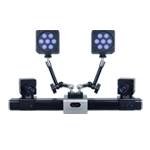
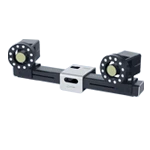
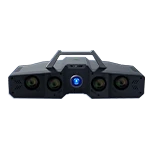
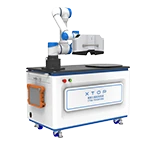
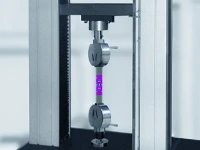
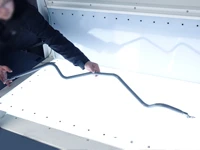
In the field of structural health monitoring, Digital Image Correlation (DIC) technology is emerging as a revolutionary tool for vibration measurement and analysis. Employing a non-contact optical measurement approach, DIC tracks high-precision displacement data from speckle patterns on an object's surface, providing engineers with full-field, three-dimensional vibration responses—thereby fundamentally overcoming the single-point limitations inherent in traditional accelerometer sensors.
Why Choose DIC Technology for Structural Vibration Monitoring?
Full-Field Strain Visualization
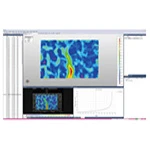
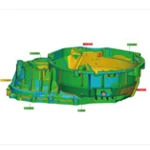
DIC 3D full-field strain systems can simultaneously capture the dynamic deformation of millions of data points across a structural surface. This generates real-time vibration displacement cloud maps and strain field distributions, enabling the precise localization of stress concentration zones.
Non-Contact, High-Frequency Acquisition
Supporting sampling rates in the kilohertz range (e.g., 1,000–100,000 frames per second), the technology accurately captures transient vibration events, making it ideal for applications such as bridge modal testing and wind turbine blade resonance analysis.
Adaptability to Complex Environments
Requiring no physical sensor installation, the system operates stably in challenging conditions—including high temperatures, high pressures, and environments with electromagnetic interference—thereby resolving monitoring challenges in specialized settings such as rotating machinery and nuclear power facilities.
Typical Engineering Application Cases
Aerospace:During aircraft wing flutter tests, a DIC system successfully captured micro-strain distributions under high-frequency vibrations reaching 1.2 kHz.
Civil Engineering:During a load test on a cable-stayed bridge, DIC full-field measurements detected a localized anomalous vibration of 0.08 mm—an anomaly that went undetected by traditional sensors.
New Energy Equipment:In fatigue testing for wind turbine blades, DIC technology provided real-time output of amplitude-phase relationship diagrams in both the flapwise and edgewise directions.
Industry Validation Data:According to recent research published in the *Journal of Experimental Mechanics*, DIC vibration measurements exhibit an error margin of less than 0.01 pixels and achieve a frequency resolution of 0.1 Hz—representing an improvement in accuracy of over 40% compared to traditional methods.