Digital image correlation (DIC) is a powerful and increasingly popular technology in the field of structural vibration measurement and modal analysis. It provides a non-contact, full-field, and high-precision measurement method that overcomes many limitations of traditional sensors (such as accelerometers and strain gauges).
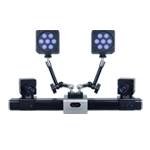
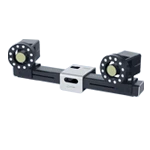
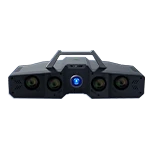
During structural vibration, two or more high-speed cameras (stereo DIC) or one high-speed camera (2D DIC, suitable for planar motion) are used to simultaneously capture a series of images from different angles. DIC software calculates the displacement change of the center point of each subset in the image coordinate system, and analyzes the three-dimensional displacement change of points on the structural surface.
For each surface point, DIC provides its three-dimensional displacement (or velocity, acceleration) time history over time, i.e., full-field vibration response data.
Advantages of DIC technology in vibration measurement:
DIC technology uses non-contact measurement and has no additional mass effect (mass load effect) on the measured structure, making it particularly suitable for lightweight, flexible, and microstructures.
Full-field measurement: Acquire vibration information (displacement, velocity, acceleration) of all points within the entire field of view at once, not just discrete points.
High spatial resolution: It can measure dense lattices, revealing local details and complex deformation patterns.
Three-dimensional displacement information: The stereo DIC provides complete three-dimensional displacement information and can capture out-of-plane vibration and torsional modes.
Suitable for complex geometries: not limited by structural shape, both planes and curved surfaces can be measured.
Wide measurement range: from static deformation to high-frequency vibration (depending on camera frame rate), from micrometers to large displacements can be measured.
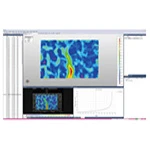
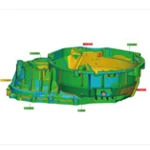
Visual and intuitive: The results are presented in the form of cloud maps, animations and other forms to intuitively display the vibration pattern of the entire field.
Application process and advantages in modal analysis:
Data collection:
A known excitation is applied to the structure, and the vibration response (displacement/velocity/acceleration time series) of the structure surface is synchronously acquired using a high-speed DIC system.
Data processing:
Vibration time history data for tens of thousands of points within the field of view are obtained. Through frequency domain transformation, a fast Fourier transform is performed on the time history data for each point to obtain its frequency response function or power spectral density.
Output response data:
The DIC software provides the response (output) of the measurement point, while the excitation force is usually measured separately by a force sensor (input).
Modal parameter identification:
Frequency domain method: This method uses multiple-input multiple-output (MIMO) frequency domain methods (such as PolyMAX, FDD) or single-reference point methods (such as CMIF). It combines the full-field response data (output) measured by the DIC with the measured excitation force (input) to identify:
Natural frequency: The frequency of structural resonance.
Mode shape: The full-field spatial shape of a structure vibrating at a specific natural frequency (this is one of the greatest advantages of DIC, providing extremely detailed and continuous mode shape visualization).
Damping ratio: Characterizes the rate at which vibrational energy is dissipated.
Time-domain methods: such as random subspace identification, which utilize only the response data measured by DIC (without measuring the input force) to perform working mode analysis under environmental excitation.
Unique advantages in modal analysis:
High-resolution mode shapes: Provides continuous, full-field, high spatial density mode shapes, which can clearly distinguish between compact modes and local modes, revealing complex deformation details (such as wave propagation and local buckling) that are difficult for traditional sensors to capture.
No mass load effect: The results are closer to the true dynamic characteristics of the structure, which is especially important for small and lightweight structures.
Directly measure displacement/strain mode shapes: In addition to acceleration mode shapes, DIC can also directly provide displacement mode shapes, which is more valuable for displacement-based design or strain fatigue analysis.
Identifying complex modes: It is easier to identify highly localized modes or modes involving complex out-of-plane motion.
Model validation: Provides extremely rich validation data for finite element models, especially for complex geometry and local effects.
Typical application scenarios:
Research on vibration characteristics of microelectromechanical systems, printed circuit boards, thin-walled structures, composite material structures, blades, wings, automotive body/chassis components, biomechanical tissues, etc.
Modal analysis of complex structures (such as whole machines or parts of bridges).
Vibration measurement of structures under high temperature or harsh environments (in conjunction with high temperature speckle resistance).
Transient impact response measurement.
Acoustic-structural coupled vibration analysis.
Model correlation analysis and finite element model correction.
DIC (Discrete Integrated Circuit) technology is used for structural vibration measurement and modal analysis. Its non-contact, full-field, and high spatial resolution characteristics give it irreplaceable advantages in acquiring complex mode shapes, studying local effects, measuring small and lightweight structures, and model verification. With improvements in hardware performance and algorithm optimization, DIC technology is becoming an indispensable and powerful tool in modern experimental modal analysis and vibration testing, especially in situations requiring precise characterization of structural dynamic behavior.