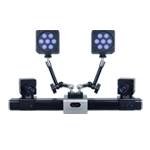
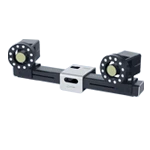
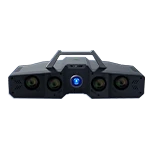
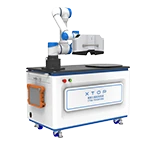
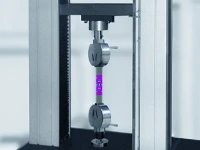
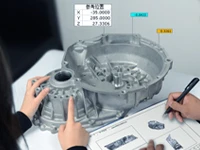
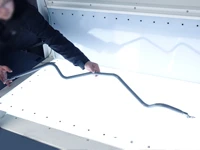
Currently, 3D-DIC has emerged as the mainstream technology; however, in specific scenarios where its planar assumption is strictly met—such as the tensile testing of thin materials or high-speed planar impact events—2D-DIC retains distinct advantages in terms of lower cost, higher speed, and simpler setup. Nevertheless, for the vast majority of engineering problems involving the real three-dimensional world, the inherent limitations of 2D-DIC (specifically, out-of-plane errors) render it incapable of meeting the requisite standards for accuracy and data completeness. 3D-DIC addresses this fundamental shortcoming, offering a more versatile and reliable solution.
For scenarios involving in-plane deformation, high-speed dynamic planar processes, or budget-sensitive projects, 2D-DIC measurement systems remain a powerful tool for resolving practical engineering and scientific research challenges, leveraging their core strengths of low cost, high efficiency, ease of operation, and rapid deployment.
The rise of 3D-DIC measurement systems to become the dominant technology in DIC applications is the inevitable result of the synergistic interplay between its intrinsic technical advantages and the maturation of the external technological landscape. Its core capability—the direct measurement of full-field 3D displacements and strains—completely eliminates errors induced by out-of-plane motion, thereby precisely addressing the urgent modern engineering and research demand for in-depth, comprehensive, and high-precision analysis of complex structures and their true deformation behaviors.
As hardware costs continue to decline and software becomes increasingly intelligent and efficient, the scope of 3D-DIC applications is expanding at an unprecedented pace, penetrating deeply from cutting-edge research laboratories into every facet of industrial R&D, production inspection, and quality control. It is no longer merely a "high-end" option, but rather the most versatile, reliable, and valuable technology of choice for resolving 3D deformation measurement challenges. Choosing 3D-DIC signifies a commitment to gaining the most authentic and profound insights into the mechanical behavior of materials and structures.
Industry Demand Drivers for 3D-DIC Technology:
Product Lightweighting and Structural Optimization: Industries such as automotive and aerospace, driven by an unrelenting pursuit of lightweight design, require increasingly precise methods to simulate and validate the deformation, strain, and failure behaviors of complex structures within a three-dimensional space.
Virtual Simulation (CAE) Validation: The full-field 3D deformation data provided by 3D-DIC serves as the most direct and comprehensive experimental basis for validating and refining simulation models, such as those generated via Finite Element Analysis (FEA).
Intelligent Manufacturing and Quality Monitoring: Within automated production lines, 3D-DIC can be utilized for inline inspection to detect deformation, gaps, or springback in complex assemblies, thereby ensuring product quality and integrity. New Materials R&D: Evaluating the three-dimensional failure mechanisms of advanced materials—such as composites and additively manufactured components—under complex loading conditions.