With the rapid development of Digital Image Correlation (DIC) technology, 3D-DIC measurement systems have undoubtedly captured mainstream attention due to their ability to acquire full-field three-dimensional deformation information. However, this does not mean that 2D-DIC measurement systems have lost their value. In specific application scenarios, 2D-DIC demonstrates its advantages, becoming an ideal choice for efficiency, economy, and reliability. This article will explore the scenarios in which 2D-DIC continues to play an important role.
I. Core Advantages: Simple, Efficient, and Economical
The core principle of 2D-DIC is to use a single high-speed or high-resolution camera to track the grayscale distribution changes of artificial or natural speckle patterns on an object's surface before and after deformation, thereby calculating the in-plane displacement (X, Y directions) and in-plane strain (εxx, εyy, εxy). Its advantage stems from its relatively simple architecture.
The system cost is significantly reduced: It only requires one camera, lens and supporting software, without the need for a complex dual (multi) camera synchronous calibration system, and the hardware investment and maintenance costs are lower than those of 3D-DIC.
Faster setup and calibration: The calibration process is relatively simple (mainly camera intrinsic parameters and scaling factor), and the system setup and debugging time is short, making it particularly suitable for occasions that require rapid deployment or frequent changes of test objects.
Lighter data processing: It only processes two-dimensional image information, with relatively small computational load, faster data processing speed, lower requirements for computer hardware, and can provide preliminary or real-time results more quickly.
Easier to operate: The learning curve for operators is relatively gentle, making it easier to get started.
II. Specific Application Scenarios of 2D-DIC Measurement Systems
2D-DIC demonstrates its application value in the following specific scenarios:
1. Rigorous in-plane deformation measurement
Scenario Description: The object under test is strictly restricted to moving within a two-dimensional plane during the test, and the displacement from the surface (Z direction) is extremely small or negligible. This is the ideal premise for 2D-DIC applications.
Typical applications:
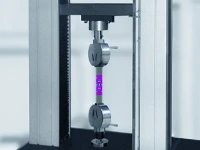
Mechanical property testing of thin sheet/film materials: such as tensile, bending, and tear tests on paper, plastic film, and metal foil. The sample thickness is thin, and the effect of out-of-plane displacement is negligible.
Thermal deformation analysis of printed circuit boards (PCBs): Analyze the in-plane thermal expansion/contraction strain distribution of PCBs under temperature cycling.
Fatigue testing of solder joints/leads in microelectronic packaging: Observing the in-plane deformation behavior of solder joints or leads under cyclic loading from a specific perspective.
Planar tensile testing of biological tissues (such as skin, vascular sections).
2. High-speed dynamic planar process capture
Scenario Description: It is necessary to capture transient, high-speed in-plane deformation processes at extremely high frame rates (thousands or even tens of thousands of fps).
Typical applications:
Ballistic impact (planar view): Study the propagation of planar deformation waves and crack propagation at the instant of projectile impact on a thin target plate (it is necessary to ensure that the high-speed camera's view is strictly perpendicular to the target plate plane).
Microsecond-level dynamic fracture of materials: capturing the rapid initiation and propagation of cracks within the material plane.
High-speed vibration modal analysis (in-plane mode): Analyzes the in-plane vibration modes of a structure under excitation at a specific frequency.
Advantages: A single high-speed camera can meet the requirements, avoiding the technical challenges and soaring costs of simultaneous operation of multiple cameras at ultra-high frame rates. The data volume is relatively small, facilitating high-speed storage and processing.
3. Large-area, long-distance planar monitoring
Scenario Description: Macroscopic in-plane deformation monitoring is required for large-scale structures (such as bridge decks, building exterior walls, and localized wind turbine blades) at a considerable distance.
The 2D-DIC measurement system provides the lowest barrier to entry into DIC technology, enabling more users (such as university teaching laboratories and small and medium-sized enterprises) to afford and benefit from advanced optical full-field measurement technology.
III. Key to Successful Application: Scene Matching and Error Control
To maximize the advantages of 2D-DIC, its application prerequisites must be strictly controlled:
Ensure flatness: The surface of the object being measured must be as flat as possible, or the displacement from the surface must be much smaller than the object distance (usually <1%). Otherwise, the displacement from the surface will introduce significant measurement errors (perspective errors).
The camera must be strictly aligned: the camera's optical axis must be as perpendicular as possible to the plane of the object being measured. The greater the angular deviation, the greater the error.
Uniform and stable illumination: Good illumination conditions are the foundation of all DIC measurements.
High-quality speckle pattern: The speckle pattern should have high contrast and randomness, and be of appropriate size.
in conclusion:
The key to choosing between 2D and 3D lies in a deep understanding of the deformation characteristics of the object under test and the core requirements of the test. When the application scenario meets the prerequisites of 2D-DIC, it can not only provide accurate and reliable in-plane deformation data, but also bring significant cost and time benefits.