In crack analysis, acquiring experimental data is only the first step. More crucial is extracting fracture parameters from displacement and strain data, such as stress intensity factor (K), J integral, crack tip opening displacement (CTOD), and crack propagation rate (da/dN). Traditional methods rely on manually "drawing lines" or "sampling points" on strain contour maps, which is not only inefficient but also highly subjective, with different operators potentially obtaining different results. Furthermore, DIC data itself contains noise (due to variations in illumination, speckle quality, camera noise, etc.). Accurately identifying the crack tip location from this noise and calculating high-precision fracture parameters presents a significant technical challenge.
I. Challenges in Crack Parameter Extraction: Noise, Singularity, and Algorithm Selection
Noise interference : The displacement field measured by DIC contains random noise (typically 0.01-0.05 pixels), and the strain field has even greater noise (because strain is the derivative of displacement). Near the crack tip, the strain gradient is extremely large, and the noise is amplified, causing "burrs" or false high strain points to appear in the strain contour map.
Crack tip location accuracy : The crack tip is a singularity in the displacement field, theoretically with an infinite displacement derivative. In actual DIC calculations, the sub-region near the crack tip loses correlation due to large deformation, resulting in missing data. Accurately deducing the crack tip location from the missing data is a challenge.
The diversity of fracture parameter calculation methods : There are multiple methods for calculating the K factor (such as displacement extrapolation, J-integral method, and interactive integration method). Different methods have different requirements for data quality and grid density, and improper selection can lead to result deviation.
Three-dimensional effect : For 3D-DIC data, the crack tip is actually a line (along the thickness direction), and it is necessary to process the three-dimensional displacement field and calculate the fracture parameters averaged along the thickness.
II. How DIC software solves these difficulties
Newtop 3D DIC software has a built-in module specifically for crack analysis, which solves the above problems through the following technologies:
Adaptive Filtering and Smoothing : The software offers various filtering algorithms (such as Gaussian filtering, median filtering, and Savitzky-Golay filtering) to suppress noise while preserving strain gradient information. Users can select the filtering window size based on the gradient magnitude at the crack tip.
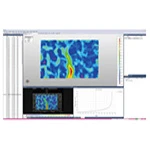
Automatic crack tip detection : Based on the singular characteristics of the displacement field (such as displacement jumps or strain concentrations), the software can automatically identify the location of crack tips. For example, the DIC software algorithm automatically marks the crack path and outputs the crack length by analyzing the gradient changes in the displacement field.
Fracture parameter calculation module : Users only need to select the crack tip location and integration path, and the software can automatically calculate parameters such as J-integral (including line integral and zone integral), K-factor (through displacement extrapolation or interactive integration), and CTOD. The calculation process conforms to international standards such as ASTM E1820 and ISO 12135.
Batch processing and automation : For fatigue crack propagation experiments, the software can automatically process thousands of images, output crack length-cycle count curves, and fit the parameters of the Paris formula. This greatly improves experimental efficiency.
III. Application Value: From Raw Data to Engineering Decisions
DIC software's post-processing capabilities transform raw data into information that can be directly used for engineering decisions. Specific benefits include:
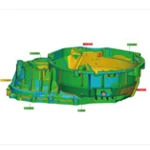
Standardized report generation : The software can automatically generate experimental reports that include strain contour plots, crack propagation curves, and fracture parameter tables, meeting the requirements of academic papers or engineering certifications.
Multi-sample comparative analysis : Through the software's data management function, crack propagation behavior under different materials and loading conditions can be compared simultaneously, allowing for the rapid selection of the optimal material or process.
Joint analysis with finite element method : DIC software supports exporting displacement field data as boundary conditions for finite element models. Simultaneously, finite element calculation results can be imported into DIC software for comparison and verification, achieving a closed-loop "experiment-simulation" process.
Machine learning data preparation : High-quality DIC crack data can be used as a training set to develop a deep learning-based crack prediction model. The software's data export interfaces (such as CSV and MATLAB formats) facilitate subsequent data mining.
IV. Case Study: Automated Analysis of High-Cycle Fatigue Crack Propagation
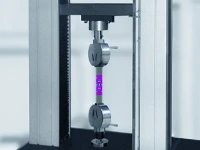
The 3D-DIC system was used to conduct high-cycle fatigue crack propagation experiments on high-strength steel. Traditional methods require manual marking of crack tips on each image, which is time-consuming and prone to errors. The DIC software, however, can identify the location of crack tips in the images and output crack length-cycle count curves. The software also automatically calculates the C and m values in the Paris formula and compares them with standard values. More importantly, the software detected several anomalies in crack propagation rates caused by load fluctuations, anomalies that are easily overlooked in manual analysis.
DIC technology not only solves the "hardware" challenges of crack measurement but also addresses the "software" challenges of data extraction and parameter calculation through powerful software post-processing capabilities. From raw images to fracture parameters, DIC software achieves full-process automation and standardization. For laboratories seeking to extract maximum value from crack experiments, choosing a fully functional DIC software system (compatible with the hardware system) is just as important as selecting a high-performance digital image correlation system . It simplifies complex crack analysis, making it reliable and repeatable, truly achieving the leap "from data to insight."