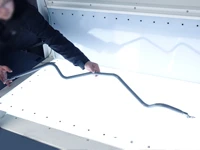
Amidst fierce competition in the automotive industry, manufacturers place a high priority on product quality and production efficiency. As a critical component, automotive glass plays a vital role in vehicle safety. Blue-light 3D scanning technology—characterized by ease of use, versatility, and high precision—has emerged as a core tool for dimensional quality control in automotive manufacturing; it effortlessly handles complex inspection requirements and fundamentally transforms traditional quality control processes.
Bottlenecks in Traditional Inspection Methods
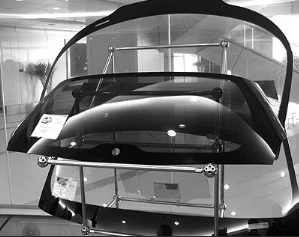
Automotive glass components feature complex shapes and require high dimensional precision; subsequent assembly processes and product performance rely heavily on dimensional consistency. However, traditional inspection methods suffer from several limitations:
1. Reliance on specialized inspection fixtures: These require matching fixtures for various specifications, resulting in high procurement costs, significant storage space requirements, and extremely poor versatility.
2. Limited measurement scope:They cannot accurately capture critical data such as positional accuracy and surface profile deviations, making it difficult to meet full-dimensional quality control requirements.
3. Low inspection efficiency: Errors frequently occur when inspecting complex curved surfaces or minute features, thereby impacting production schedules.
The application of blue-light 3D scanning technology perfectly resolves these pain points. It eliminates the need for specialized fixtures, allows for interchangeable industrial camera lenses and flexible switching between measurement fields of view, and enables the rapid, precise capture of subtle features on curved glass surfaces. By providing a comprehensive, multi-dimensional view of dimensional deviations, it makes quality control both more efficient and more accurate.
Blue-Light 3D Scanning Inspection Solution
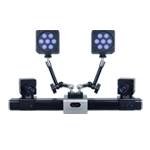
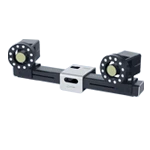
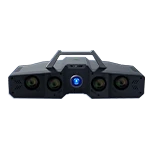
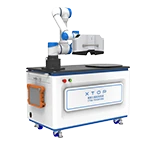
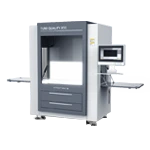
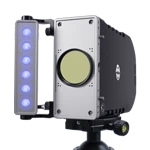
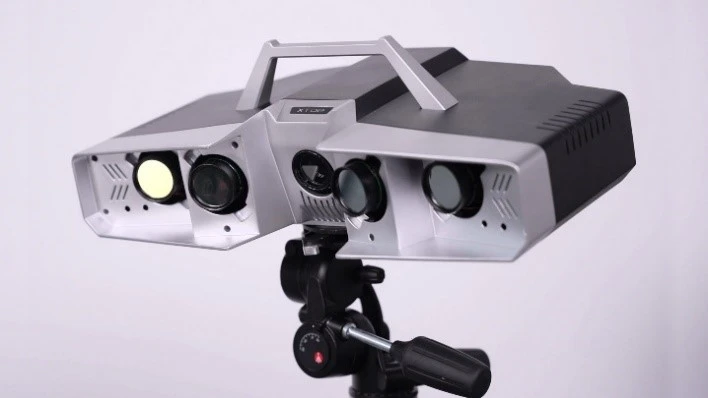
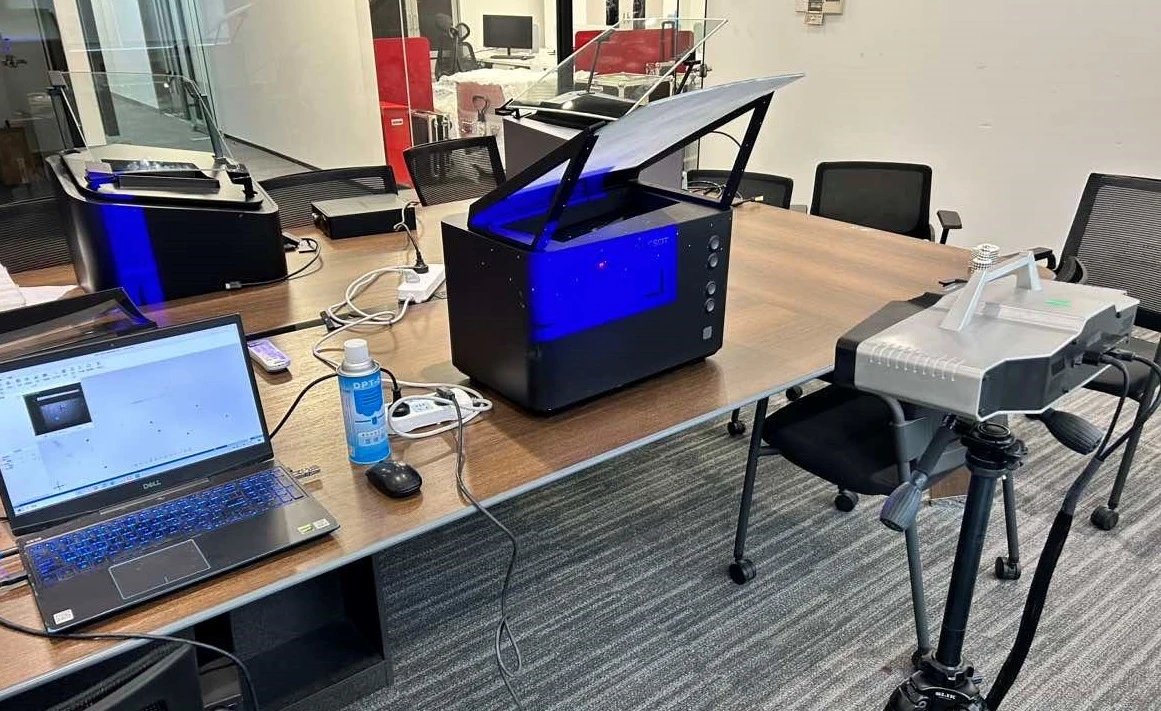
Utilizing the XTOP3D XTOM blue-light fringe projection 3D scanner, this solution scans the bottom surface of the upper glass and the top surface of the lower glass. By comparing the data from these two surfaces, full-dimensional error analysis can be performed directly.
Key Advantages:
Ultra-high precision: Single-shot accuracy reaches the micron level, meeting tolerance inspection requirements for automotive glass.
Non-contact: Prevents scratches or deformation caused by pressure on the delicate glass surface.
High-efficiency scanning: Single-shot scan time is ≤1 second, significantly boosting inspection efficiency.
Superior detail capture: Accurately reproduces complex features such as curved surfaces, edges, and hole locations.
High-precision scanning software: Features powerful algorithms for 3D reconstruction, rendering, and post-processing, ensuring rapid scanning speeds and repeatable accuracy.
3D Full-Scale Inspection Process
1. Workpiece Preparation
Evenly apply a developer spray to the surface of the workpiece (this has a negligible impact on accuracy—for instance, a single application of titanium powder results in a dimensional change of only 1–2 µm) to ensure that the blue-light scanner can capture data with high stability and precision.
2. 3D Scanning and Global Point Stitching
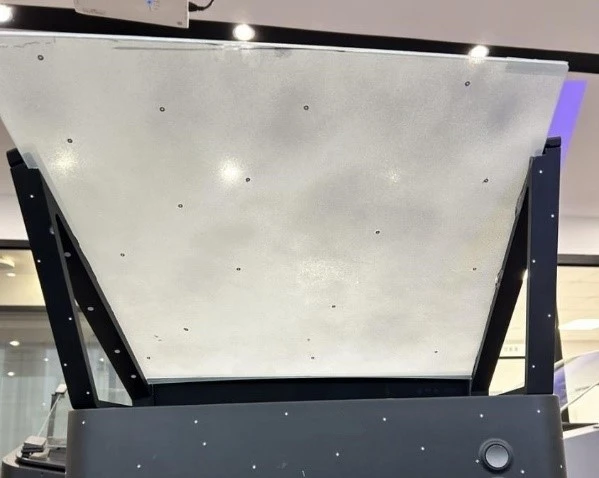
Secure the glass workpiece onto the measurement platform to ensure stability. Perform multi-angle 3D scanning around the workpiece to collect data. The 3D scanning software automatically identifies shared reference markers and converts all local scan coordinate systems into a unified global coordinate system in real time; this enables high-precision, seamless, and automatic point cloud stitching, resulting in a complete 3D data model of the glass workpiece.
3. 3D Dimensional Inspection and Analysis
Point Cloud Processing: Perform optimization tasks—such as noise reduction and smoothing—on the stitched, complete point cloud.
CAD Model Import: Import the original design CAD model of the glass.
Coordinate Alignment: Precisely align the scanned 3D model with the theoretical CAD model within the inspection software using best-fit or feature-based alignment methods.
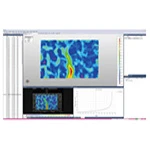
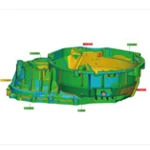
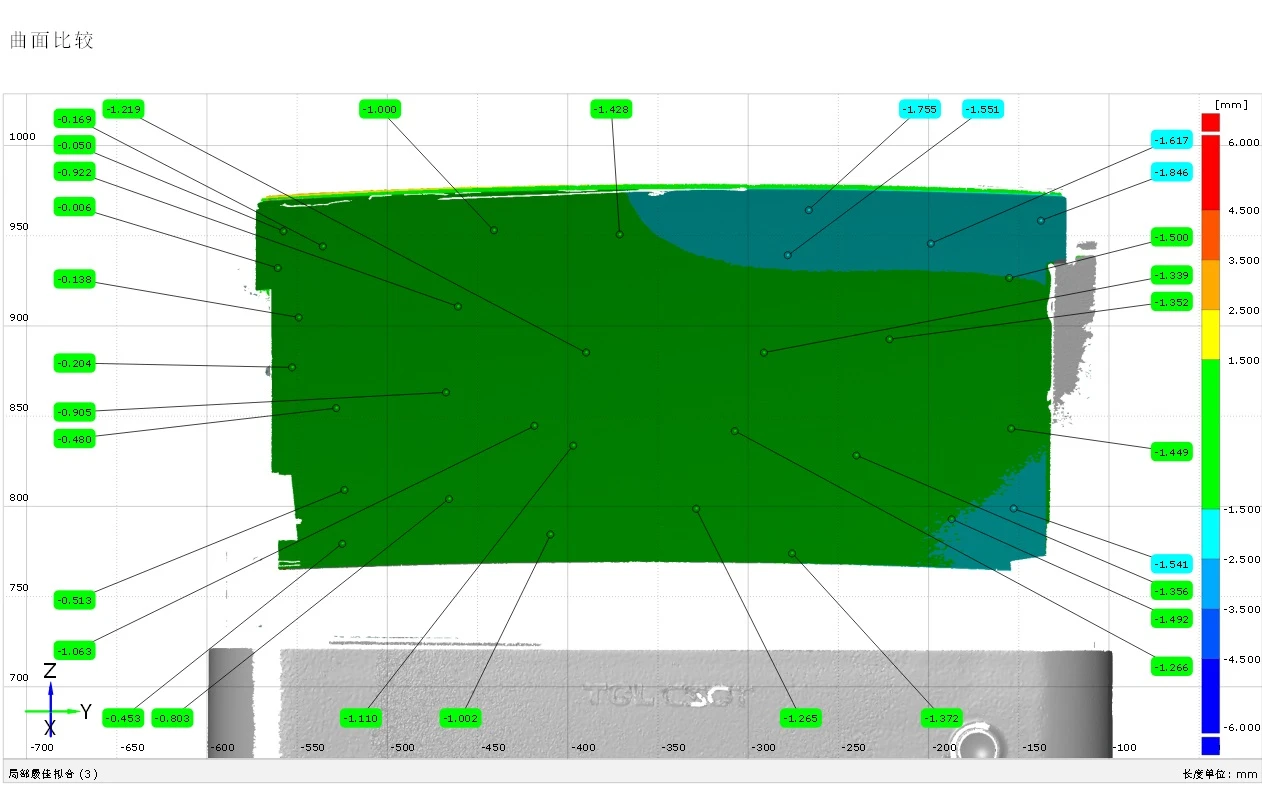
3D Comparative Analysis (Color-coded Comparison Results – GD&T):
GD&T Analysis: Compare the scanned model against the design CAD model in real-time; automatically calculate key tolerances such as curvature continuity, profile, flatness, and thickness uniformity.
Defect Localization: Use 3D deviation color maps to visually identify localized deformation areas (e.g., micro-depressions, waviness).
Mounting Point Verification: Precisely analyze the positional accuracy of locating holes/pins to ensure seamless fitment with the vehicle frame.
Report Generation: Automatically generate quality reports containing quantitative deviation data, color maps, and key cross-section analyses; supports SPC (Statistical Process Control).
IV. Inspection Results and Value
By combining blue-light 3D scanning technology with global point-stitching methods, this approach offers an efficient solution for the high-precision, full-dimensional inspection of automotive glass. It enables rapid, comprehensive, and accurate dimensional quality control for glass with complex curvatures, significantly enhancing quality control capabilities and efficiency in the manufacturing process, while effectively ensuring final product quality as well as vehicle safety and aesthetics.
Comprehensive Oversight: Captures high-precision data covering the entire surface and all dimensions of the glass component.
Precise Localization: Uses color maps to pinpoint specific areas where dimensions fall outside tolerance limits (e.g., edge deformation, surface collapse, or localized protrusions).
Data-Driven Insights: Provides precise data to guide process improvements, such as mold adjustments and the optimization of forming processes.
Enhanced Quality Control: Shifts the workflow from spot checks to full inspections or high-frequency sampling, thereby improving product consistency and increasing pass rates.