Materials science labs, quality control labs, and university mechanics labs conduct extensive strain testing daily, with strain gauges, contact extensometers, and the DIC 3D full-field strain measurement system being the three main pieces of equipment. Incorrect selection can lead to data deviations, test rework, and invalid reports. Combining authoritative testing theories with mainstream application cases from 2026, this article compiles a table comparing the core parameters, applicable scenarios, advantages, and disadvantages of these three types of equipment to help labs quickly select strain measurement equipment and avoid testing risks.
First, it's crucial to clarify the core positioning of the three main pieces of equipment. None of them are inherently superior or inferior; the measurement objective dictates the equipment selection—this is the first principle of strain testing. Extensometers = average strain along the gauge length (standard test), strain gauges = local strain at a single point (fixed-point monitoring), and DIC = three-dimensional strain across the entire field (global deformation and damage analysis). The "strain data" collected by these three devices have different definitions and should never be directly compared or mixed.
1. Comparison of core parameters and advantages/disadvantages of the three main types of equipment
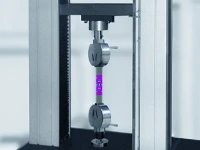
Contact extensometer
Advantages: It is an industry-standard equipment with stable data, metrological traceability qualifications, simple operation, and moderate cost. It is the legally mandated equipment for testing the tensile strength, yield strength, and elastic modulus of metallic materials.
Disadvantages: Contact clamping can easily damage brittle materials, soft films, and thin-walled specimens; it can only obtain average data within the gauge length and cannot observe local strain concentration and deformation distribution; the specimen needs to be detached in time before fracture, making it unsuitable for full fracture analysis.
Applicable scenarios: Standardized mechanical testing of metallic materials and routine testing that requires the issuance of compliant test reports.
strain gauge
Advantages: Compact size, flexible installation, can be placed in confined spaces and complex structural surfaces, supports multi-point synchronous monitoring, and is suitable for long-term fatigue testing and structural health monitoring.
Shortcomings: The bonding process requires high precision, and the quality of the bonding directly affects the accuracy of the data; single-point measurement is only used, while full-area testing requires a large number of bonding pads, resulting in extremely low efficiency; the bonding adhesive layer may change the local stiffness of thin-walled samples, introducing test errors.
Applicable scenarios: fixed-point strain monitoring of structural components, fatigue testing, long-term online monitoring, and local strain acquisition in confined areas.
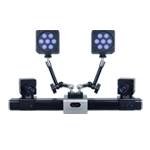
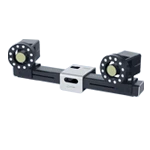
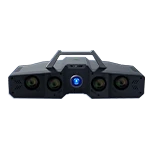
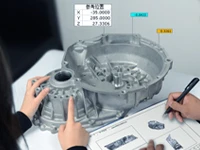
DIC Three-Dimensional Full-Field Strain Measurement System
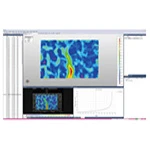
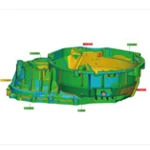
Advantages: Non-contact measurement, zero-damage to specimens; millions of measurement points across the entire field, outputting strain cloud maps and displacement fields, visualizing the entire deformation process; strain range of 0.005%-2000%, adaptable to all scenarios from small deformation to large deformation; supports extreme working conditions such as high and low temperatures, dynamic impact, and high-speed loading, and can be connected to testing machines, thermal imagers, and other equipment to collect data synchronously.
Disadvantages: Initial setup requires speckle pattern creation and equipment calibration, and there is a learning curve for beginners; large-area testing requires a multi-camera setup.
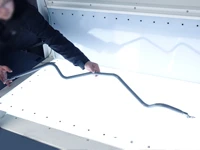
Applicable scenarios: composite material testing, crack/notch strain analysis, large deformation materials, dynamic mechanical testing, finite element simulation benchmarking, and failure mechanism research.
2. 2026 Mainstream Experimental Scenarios Selection Comparison Table
For routine tensile testing, elastic modulus, and yield strength testing of metals, extensometers are preferred.
Fixed-point fatigue monitoring of steel structures and mechanical components → priority strain gauges
Composite material tensile, delamination damage, and interface failure analysis → Priority DIC 3D strain measurement system
Strain concentration testing at hole edges, notches, and crack tips → DIC > strain gauge, extensometer disabled (average data masks peak values).
For testing polymer films, soft materials, and thin-walled samples, prioritize DIC (non-contact) to avoid damaging the samples with contact equipment.
Large deformation materials, sheet metal forming limit testing → Priority DIC three-dimensional strain measurement system
Dynamic impact, high-speed loading, vibration deformation testing → Prioritize DIC high-speed measurement module
3. Adaptation to laboratory scientific research applications
For the same test item, data from different devices cannot be used interchangeably. Test reports must indicate information such as measurement method, gauge length, measurement point location, and DIC parameters.
When using the DIC three-dimensional strain measurement system, speckle pattern creation, illumination, and calibration are key to data accuracy. DIC equipment is usually accompanied by complete operating specifications and technical guidance to reduce human error.
When testing non-uniform or anisotropic materials, traditional single-point/gauge length equipment should be abandoned in favor of full-field DIC measurement to avoid data distortion from the source.
For modern integrated laboratories, the optimal configuration is an extensometer + strain gauge + DIC (Diverterless Insulation) system: the extensometer handles standardized routine tests, the strain gauge handles long-term fixed-point monitoring, and the DIC three-dimensional strain measurement system tackles complex materials, cutting-edge scientific research, failure analysis, and other challenging tests. This system can be customized to comprehensively cover all strain measurement needs.