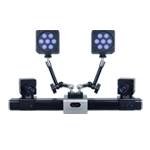
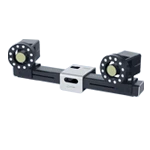
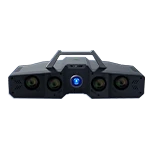
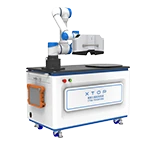
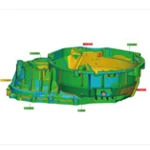
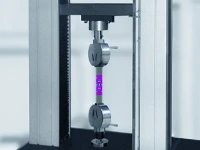
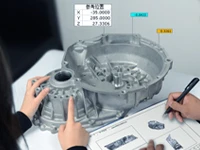
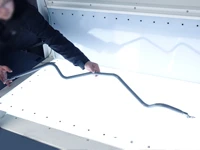
A multi-camera array is a stereo, digital image correlation (DIC) measurement system consisting of three or more pairs of cameras. Multi-camera DIC measurement systems enable testers to perform large-scale, complex surface profile measurements on curved surfaces and large-scale structures, expanding the field of view ( FOV ). Multiple cameras provide a more comprehensive view without compromising spatial accuracy, making complete visualization measurements possible. It does not rely on increasing the resolution of each camera, but rather effectively improves spatial resolution by increasing the number of existing cameras, thereby enhancing the measurement accuracy of DIC.
When multiple areas of a test object need to be imaged simultaneously or dense full-field data is required, conventional 3D-DIC (one pair of cameras) cannot fully cover the entire region of interest (ROI). In a multi-DIC measurement system, camera lenses can be freely arranged in a cluster, and the data is stitched together by software for further processing. For example:
-
Single-sided array for testing large, complex surfaces (wings, blades, beams, and walls);
-
Arc-shaped array, testing the surface of a circle/cylinder/sphere (objects that expand under pressure);
-
Dual-plane array for measuring cross-sectional thickness/neckback, true strain, etc.
To achieve continuous full-surface measurement, each local portion should be covered by at least one set of three-dimensional data subsystems (FOV) to successfully reconstruct each point on the measured surface; adjacent local portions should meet certain overlap requirements to ensure the integrity of continuous deformation measurement; calibration is used as a transformation medium between the local coordinate system and the global coordinate system.
Most camera sensors have an aspect ratio between 1:1 and 2:1. If a single camera pair is used to measure objects with a large aspect ratio (wings, propellers, beams, etc., all above 5:1), many pixels will not be utilized, resulting in fewer effective data points and poor spatial resolution. Replacing the camera with an ultra-high resolution camera is often limited by cost, so integrated camera arrays have been widely used in aerospace and other fields.
The core advantages of multi-camera DIC
1. Ultra-wide field of view coverage
The field of view of a single-camera DIC system is limited by the lens focal length and camera resolution. When measuring large objects, a difficult trade-off must be made between resolution and field of view. Multi-camera systems, through the proper arrangement of multiple cameras, can easily cover measurement ranges from a few centimeters to tens of meters while maintaining micrometer-level spatial resolution.
2. Complete measurement of complex curved surfaces
For complex curved surfaces such as spheres, cylinders, and parabolas, a single camera can only obtain local deformation data, and the accuracy in the edge areas of the surface is severely reduced. A multi-camera system observes simultaneously from multiple angles, which can obtain complete three-dimensional displacement information for every point on the surface, truly achieving "what you see is what you measure".
3. High dynamic range measurement
In high-speed dynamic events such as impacts and explosions, single-camera systems often struggle to simultaneously meet the requirements of temporal and spatial resolution. Multi-camera synchronous acquisition technology can complete multi-frame acquisition with nanosecond-level temporal accuracy, fully recording every detail of the transient process.
4. Enhanced measurement reliability
Multi-camera redundant observation can effectively identify and eliminate erroneous matching points, improving the reliability of measurement results. When the image quality of one camera is affected, other cameras can still provide valid data, ensuring the successful completion of the measurement task.
Technical Indicators Comparison
|
index
|
Single Camera DIC
|
Multi-camera DIC
|
|
Maximum field of view
|
Limited by a single lens
|
It can reach tens of meters
|
|
Surface measurement accuracy
|
Low edge precision
|
Uniform and high precision across the entire field
|
|
Dynamic measurement capability
|
limited
|
Supports high-speed impact measurement
|
|
Data integrity
|
Some areas are missing due to obstruction.
|
Multi-faceted complementarity and completeness
|
|
System complexity
|
Simple
|
Medium to high
|
Typical application scenarios
Multi-camera DIC technology is particularly suitable for the following measurement scenarios:
Spherical structure overall surface measurement : satellite fairing, spherical tank, lens, optical components, etc.
Full-field deformation analysis of large-scale structures : bridges, large-scale composite material fuselages, ship structures, etc.
Integrity inspection of complex curved surfaces : turbine blades, engine casings, medical implants, etc.
High-speed transient process observation : shock wave propagation, material fracture, ballistic analysis, etc.
Multi-camera DIC technology represents a significant development direction in the field of optical measurement. It not only inherits the advantages of traditional DIC technology—non-contact, full-field measurement, and ease of operation—but also achieves a qualitative leap in measurement range, accuracy, and data integrity. With the continuous decline in the cost of optical components and the constant advancement of algorithm technology, multi-camera DIC systems are becoming standard tools for research institutions and industrial enterprises to perform complex measurement tasks.
If you are looking for a DIC solution capable of handling the challenges of measuring spherical surfaces and large dimensions, a multi-camera DIC measurement system is undoubtedly a top priority. In the next article, we will delve into the specific applications and key technical details of multi-camera DIC technology in the measurement of spherical surface structures.