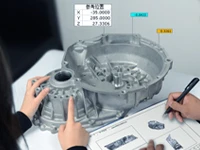
The goal of modal analysis is to determine the natural frequencies and mode shapes of each order, providing a basis for the dynamic characteristic analysis and optimization of structural systems. Modal analysis of automotive brake discs (brake discs) is beneficial for solving noise problems, the root cause of which is the tangential vibration of the friction pads on the brake disc. Modal analysis can measure and determine the natural frequencies corresponding to the vibration.
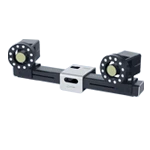
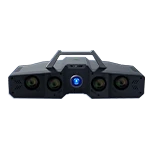
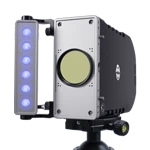
Digital image correlation (DIC) technology is increasingly being accepted by researchers due to its superior testing results. In this automotive brake disc modal test, the FFT vibration modal analysis function module of the Xintuo 3D high-speed DIC measurement system was used. The digital image correlation (DIC) technology, combined with a high-speed camera, captured a sequence of speckle images of the specimen under simulated working conditions, and performed instantaneous hammer impact excitation and modal analysis on the automotive brake disc.
High-speed DIC technology for brake disc hammer impact modal testing
Test Background
Modal characteristics are the inherent vibrational properties of a structure. Each mode has a specific natural frequency, damping ratio, and mode shape. Modal parameters can be obtained through calculation or experimental analysis, and this information is crucial for understanding and predicting the dynamic behavior of a structure. In practical engineering applications, potential structural problems, such as resonance and excessive vibration, can be identified, which helps in optimizing the structural design and improving its stability and reliability.
Using a high-speed DIC measurement system and FFT vibration modal analysis technology, vibration and modal analysis of brake discs can be performed. Modal testing and analysis of brake discs can be achieved simply by placing markers on the surface of the brake disc and tracking the motion behavior of these markers during vibration.
Test objective
1) Obtain the modal parameters of the brake disc (natural frequency, damping ratio, mode shape).
2) 3D visualization presents the actual vibration of the brake disc, and the variation law of the brake disc during vibration is studied and analyzed in combination with modal parameters.
DIC Technology Modal Analysis Solution
A high-speed DIC measurement system and FFT vibration modal analysis technology were used to perform modal testing and analysis on the samples.
By combining image acquisition from a high-speed camera with impact testing, the vibration modal analysis of the brake disc is performed using FFT vibration modal analysis software.
Test results
Point acceleration can be obtained by tracking the speckle pattern on the sample surface, and the motion behavior information of the entire field can be obtained using the Xintuo 3D high-speed DIC measurement system.
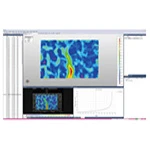
Brake disc full-field displacement data was obtained through analysis using Xintuo 3D DIC software. After extracting the measured full-field displacement data and performing global noise reduction, Fast Fourier Transform (FFT) was applied to the displacement data of each point on the brake disc surface.
FFT vibration modal analysis software can analyze and process the full-field amplitude of the brake disc surface and the average amplitude corresponding to each frequency in the x, y and z directions, then identify multi-order special working deformation information (ODS) and vividly present it in an animated manner.
FFT vibration modal analysis software can be used to perform FFT analysis on a single point of the brake disc or on the entire field. Additionally, OMA (Operating Modal Analysis) can be performed, enabling analysis of in-service structures or systems under actual operating vibration conditions. It can efficiently extract modal parameters for environmental vibrations or external excitations (such as traffic loads).
The FFT vibration modal analysis software, combined with digital image correlation (DIC) technology, performs working deformation ODS analysis and working modal analysis (OMA) through transient image acquisition, obtaining full-field 3D strain and displacement data of the specimen structure. It also supports the display of these data together with vibration data, which can provide a basis for the analysis of system vibration characteristics, vibration fault diagnosis and prediction, and optimization of structural dynamic characteristics.