Applying three-dimensional digital image correlation (3D-DIC) to extreme environments with temperatures of 1000°C, 1500°C, and even higher presents a challenging frontier in science. Problems such as intense thermal radiation, speckle failure, thermal disturbances, and calibration drift act as layers of barriers, hindering a deep understanding of the behavior of materials and structures at high temperatures. However, with continuous innovation in optics, materials, and algorithms, a series of cutting-edge technologies and solutions are constantly breaking through these bottlenecks, significantly expanding the measurement boundaries and application potential of high-temperature DIC.
Challenge 1: Imaging difficulties in the "fog" of thermal radiation
The essence of the problem: The intense infrared radiation emitted by the high-temperature object itself (especially in the near-infrared and visible light bands) far exceeds that of the external lighting source, causing the camera sensor to saturate or the signal-to-noise ratio to drop sharply, and the surface texture information (speckle) of the object is completely overwhelmed.
Cutting-edge solutions:
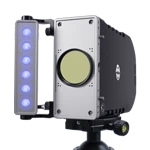
Narrowband active illumination + ultra-narrowband filtering: This is currently the most mainstream and effective solution. It uses high-power LEDs or lasers with specific wavelengths (typically blue or ultraviolet light, such as 447nm or 405nm) as the illumination source. A bandpass filter with an extremely narrow bandwidth (typically <5nm, or even 1-2nm) is installed in front of the camera lens. The center wavelength of this filter precisely matches the peak wavelength of the illumination source. This method can extremely effectively block the broadband thermal radiation emitted by the object itself, allowing only the reflected illumination light signal to pass through, significantly improving image contrast. The latest systems can obtain clear images at temperatures of 1600°C or even higher (Optics and Lasers in Engineering, 2023).
Short-pulse illumination and gated imaging: This technique utilizes nanosecond or picosecond-level short-pulse light sources in conjunction with high-speed cameras equipped with electronic shutters (gating). By precisely controlling the synchronization time (gating width) between the light source pulses and the camera exposure, motion can be "frozen" within an extremely short time window, capturing image signals primarily contributed by the illumination light and effectively suppressing continuous thermal radiation background noise. This is particularly effective for measuring transient high-temperature processes (such as explosions and shock heating) (Applied Optics, 2023).
Spectral separation and multi-camera fusion: Utilizing the difference between the radiation and reflected light spectra of high-temperature objects, multiple cameras equipped with different filters are used, combined with algorithms, to separate the reflected light signal. Alternatively, DIC measurements can be performed in the visible light band, while an infrared camera independently measures the temperature and compensates for the effects of thermal radiation (still under investigation).
Challenge Two: The "Identity Marker" Crisis Under High Temperatures - Speckle Stability
The essence of the problem: Traditional paint and ink speckles oxidize, carbonize, peel off, volatilize, or change color drastically at high temperatures, causing the speckle pattern to fail and DIC calculations to lose their tracking basis.
Cutting-edge solutions:
High-performance ceramic-based coatings: These coatings utilize high-temperature resistant ceramic powders such as alumina (Al2O3), zirconium oxide (ZrO2), and yttrium-stabilized zirconium oxide (YSZ) as pigments, combined with high-temperature resistant inorganic binders (such as water glass, phosphates, and silica sol). By optimizing particle size distribution and spraying processes, high-contrast, highly stable speckle patterns are achieved. These coatings can operate stably at temperatures ranging from 1000-1400°C for extended periods (Surface & Coatings Technology, 2023).
Laser surface modification: High-power pulsed lasers (such as nanosecond and picosecond lasers) are used to directly ablate, melt, or oxidize the surface of metals, ceramics, or C/C composite materials to form micro-pits, protrusions, or oxide spots with high contrast. The speckle formed by this method is integrated with the substrate, has a temperature resistance up to the melting point of the substrate, and has no risk of peeling (Optics and Laser Technology, 2023).
Plasma spraying/micro-arc oxidation: A thin layer of high-temperature resistant ceramic (such as Al2O3) that matches the thermal expansion coefficient of the substrate is sprayed onto the substrate surface, and speckles are made on it; or a ceramic layer is grown in situ on the metal surface through micro-arc oxidation to form natural or controllable textures.
High-temperature stable quantum dots: Exploring quantum dot materials with specially formulated luminescent properties that remain stable at high temperatures, which can be used as active speckle sources (currently in the laboratory research stage).
Challenge 3: The Ubiquitous Ghost of Thermal Disturbance - Thermal Drift and Air Turbidity
The essence of the problem: High-temperature environments cause drastic changes in air density (thermal disturbance), resulting in fluctuations in the refractive index of light; the camera, lens, support, and the measured object itself expand due to heat (thermal drift). These effects introduce time-varying systematic errors unrelated to actual deformation.
Cutting-edge solutions:
Active/passive thermal control and environmental shielding: Water-cooled/air-cooled jackets are used for thermal stabilization of cameras and lenses; transparent (such as quartz glass) or perforated heat shields are used in the test area to reduce the disturbance of hot air convection to the optical path; the optical path is shortened as much as possible or a shielding gas at a constant temperature is introduced into the optical path.
Background reference point correction: Reference points with high-stability speckle patterns, unaffected by loads, are fixed in the field of view (typically using the same material as the specimen or a low-expansion material, placed in the same temperature range). During DIC calculations, the apparent displacement of these reference points is monitored to estimate and subtract the overall system drift (including camera movement and thermal expansion effects) (Measurement Science and Technology, 2023).
Thermal expansion compensation based on a physical model: If the coefficient of thermal expansion (CTE) and temperature field distribution of the material under test are known (obtainable via infrared thermometry or thermocouples), the displacement component calculated from pure thermal expansion can be subtracted from the DIC displacement field to obtain the true deformation caused only by mechanical load. This requires high-precision temperature field measurement.
Time series analysis and filtering: Taking advantage of the low-frequency characteristics of system drift (relative to the actual mechanical deformation response), and combining time series analysis and filtering techniques such as wavelet transform, the drift signal is separated from the actual deformation signal.
Multi-scale DIC and global optimization algorithms: Develop more robust DIC algorithms that are more resistant to slow global drift.
Challenge 4: Inaccurate "ruler" under high temperatures - System calibration and stability
The essence of the problem: Under high temperatures, the internal parameters of the camera (focal length, distortion, principal point) may change due to thermal expansion; the calibration plate may deform and fail under high temperatures; and on-site calibration cannot be performed under high temperatures.
Cutting-edge solutions:
High-precision calibration at room temperature + thermal deformation modeling: Extremely rigorous system calibration is performed at room temperature. Through experiments or finite element analysis, the deformation characteristics of the camera lens system (especially the protective window) under heat are studied, and a thermal deformation model is established. During high-temperature measurements, the calibration parameters are corrected online using temperature monitoring data and this model (Precision Engineering, 2023).
Calibration plate-free self-calibration technology: Utilizing fixed points of known geometric features of the test piece itself or in the scene (such as multiple coplanar or specifically arranged high-temperature resistant markers), combined with photogrammetry principles, the deformation field and camera parameters are optimized simultaneously during the measurement process (still under exploration, accuracy needs to be improved).
High-stability calibration target design and high-temperature calibration: Develop a high-temperature dedicated calibration target made of ultra-low expansion materials (such as silicon carbide and Invar), and attempt to perform on-site calibration at specific high-temperature points (complex operation and limited application).
Outlook: Intelligent Integration and Limitless Expansion
The future development of high-temperature DIC technology will place greater emphasis on the intelligent fusion of multiphysics and the expansion of its ultimate capabilities.
Deep integration with infrared thermometry (IRT): DIC provides full-field deformation and strain, while IRT provides full-field temperature. The two are precisely synchronized in time and space to achieve true thermo-mechanical coupling full-field measurement, providing the most complete verification data for complex models.
AI-powered DIC algorithm: Utilizes deep learning to improve speckle image quality (noise reduction, enhancement), optimize DIC calculation efficiency and accuracy, intelligently identify and compensate for complex thermal drift patterns, and automatically identify damage and failure.
For higher temperatures (>1800°C) and harsher environments: Explore new speckle techniques applicable to ultra-high temperature ceramics and refractory metals; develop optical window materials and camera protection solutions that can withstand higher temperatures; and study stable measurements in strongly oxidizing and corrosive atmospheres.
High-temperature DIC at the micro- and nano-scale: By combining microscopic optical systems, the high-temperature DIC capability is extended to the micrometer or even nanometer scale to study the microstructural deformation behavior of materials at high temperatures.
Every breakthrough in high-temperature 3D DIC testing technology signifies a deeper understanding of the behavior of materials and structures under extreme service environments. From precise optical filtering to innovative speckle fabrication, from intelligent thermal drift compensation to robust algorithm design, these cutting-edge technologies and solutions are continuously expanding the boundaries of high-temperature DIC, making it a powerful engine supporting breakthroughs in advanced energy, aerospace, and high-end manufacturing. With continued technological evolution, 3D DIC technology will penetrate even higher temperatures, revealing more mechanical mysteries hidden in extreme environments.