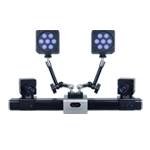
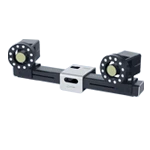
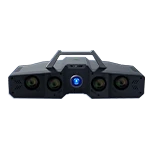
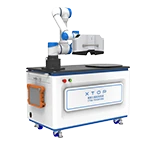
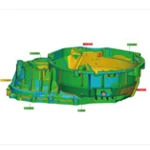
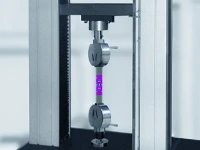
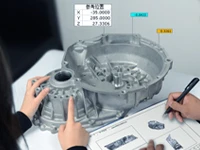
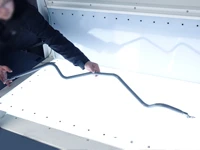
Due to the limited resolution of cameras, the effective field of view is also limited, making it difficult to monitor the entire area. For example, if an object with a large aspect ratio completely covers the camera's field of view, it will result in a large area of wasted field of view along the short side, reducing the camera's effective pixels and the system's measurement accuracy. Secondly, objects with large curvature cannot be completely covered by two camera views simultaneously, and their mechanical properties may be completely different in different directions. Therefore, measuring only one surface of an object cannot represent the actual changes in the entire field of view. Multi-camera 3D digital image correlation can solve these problems. By recording images of the object's surface through three or more different camera angles, it can make full use of camera resolution and obtain the full-field 3D image deformation results.
A multi-camera 3D digital image correlation system combines multiple cameras in pairs to form a traditional dual-camera 3D digital image correlation system. Each system tests the deformation and displacement of a different region. Through a series of calibration methods, the 3D data of each subsystem is transformed and mapped to the same principal coordinate system, and the unified test results of each subsystem are calculated. The multi-camera 3D digital image correlation system arranges the cameras in a parallel array, with each group of systems recording a portion of the region. Every two adjacent systems have an overlapping area. 3D residuals are used as a standard to reduce reconstruction errors.
Choosing the right multi-camera DIC system from the market is a common challenge for many users. It requires meeting their measurement needs while also offering technical support and timely after-sales service. This article provides a comprehensive guide to selecting a multi-camera DIC system, covering technical parameters, performance indicators, system configuration, and service support.
Interpretation of core technical parameters
Camera resolution
Camera resolution is the most fundamental parameter that determines measurement accuracy. Resolution is usually expressed in pixels, such as 20 megapixels, 45 megapixels, etc.
Selection Recommendations :
- For precision measurements of standard sizes (within 1 meter), a camera with 25 megapixels or higher is recommended.
- For large-scale measurements (over 1 meter), the resolution can be selected between 12 megapixels and 45 megapixels, depending on the field of view requirements.
It's important to note that higher resolution means larger data volumes and longer processing times.
Acquisition speed
The acquisition speed determines the system's ability to capture dynamic processes, and the unit is usually frames per second (fps) or thousands of frames per second (kfps).
Selection Recommendations :
- Static or quasi-static measurements (deformation time exceeding 1 second): 100-500fps is sufficient.
- Medium-speed dynamic process (deformation time 0.01-1 second): requires 1000-10,000 fps
- High-speed impact process (deformation time less than 0.01 seconds): requires over 10,000 fps, with high-end systems reaching 1 million fps.
Measurement accuracy
The measurement accuracy of the DIC system includes two aspects: spatial accuracy and strain accuracy.
- Spatial accuracy : refers to the absolute error in displacement measurement, usually expressed in pixels or physical dimensions.
- Strain accuracy : refers to the relative error in strain calculation, usually expressed in με (micro-strain).
Selection Recommendations :
- General scientific research applications: displacement accuracy better than 0.02 pixels, strain accuracy better than 50 με
- Industrial inspection applications: Displacement accuracy better than 0.01 pixels, strain accuracy better than 30 με
- High-precision measurement applications: displacement accuracy better than 0.005 pixels, strain accuracy better than 20 με
Key performance indicator evaluation
Field of view coverage capability
Field of view coverage is one of the core advantages of multi-camera DIC systems. The following should be considered during evaluation:
- Maximum field of view for a single camera
- Maximum number of cameras that can be expanded
- Total field of view after multi-camera stitching
- Maintain measurement accuracy in the field of view edge region
Selection Recommendations :
Determine your maximum measurement size and choose a system with ample margin in field of view coverage. It is recommended to choose a system that can cover at least 1.5 times the expected maximum size to allow for future expansion.
Surface adaptability. For measuring complex geometries such as spheres and curved surfaces, surface adaptability is crucial. Evaluation criteria include:
- Does it support parametric measurement of regular curved surfaces such as spheres and cylinders?
- Uniformity of surface measurement accuracy across the entire field
- Maturity of surface stitching and fusion algorithms
- Does it support online surface fitting and real-time display?
Selection Recommendations :
If the object you are measuring contains curved surfaces, be sure to choose a system with proven surface measurement capabilities. You can request a demonstration or test data on surface measurement from the supplier.
Data processing capability. Multi-camera systems generate massive amounts of data, and data processing capability directly impacts work efficiency.
Does the software support GPU-accelerated computing?
- The degree of matching between processing speed and acquisition speed
- Does it support distributed parallel processing?
- Data storage format and compatibility
Selection Recommendations :
For large-scale measurement projects, it is recommended to choose a system that supports GPU acceleration and parallel processing. You can request the vendor to provide measured data on processing speed.
System configuration scheme selection
Industrial camera lens selection
Lens selection requires comprehensive consideration of field of view, resolution, and working distance:
- Wide-angle lens : Suitable for large field-of-view measurements, but with significant edge distortion.
- Standard lens : Less distortion, suitable for medium-sized measurements.
- Telecentric lens : Eliminates perspective errors, suitable for precision measurement
- Zoom lenses : High flexibility, but lower repeatability.
Lighting scheme
A suitable lighting scheme is crucial for successful measurements:
- LED surface light source : good uniformity, low heat generation, suitable for most applications
- Coaxial light source : Effectively eliminates specular reflections, suitable for smooth surfaces.
- Stroboscopic light source : Provides high-intensity illumination instantly, suitable for high-speed measurements.
- Ring light source : Reduces the impact of shadows, suitable for three-dimensional structures.
DIC Software Functional Evaluation
Basic functions
- Real-time preview and parameter adjustment
- Automatic calibration and distortion correction
- Multi-camera synchronous acquisition control
- Displacement and strain field calculations
- Data export and report generation
Advanced features
- Surface fitting and parametric measurement
- Sub-pixel matching accuracy improvement algorithm
- Strain localization analysis
- Data exchange with finite element software
- Automated measurement script support
Service support considerations
Pre-sales service
- Is free technical consultation provided?
- Can you customize a measurement solution according to your needs?
- Does the system support on-site demonstrations or sample testing?
- The technical team's professional background and experience
Training support
- Is system operation training provided?
- Are the technical documents and case studies complete?
- Does it support remote technical support?
Cost-performance analysis
Initial investment considerations
When evaluating the system price, the following factors need to be considered:
- Hardware costs such as cameras and lenses
- Software license fees
- Cost of accessories and consumables
System integration and installation/commissioning costs
Long-term usage costs
- Equipment maintenance and calibration costs
- Software upgrade costs
- Spare parts replacement cycle and cost
- Energy consumption and material costs
Choosing a suitable multi-camera DIC system is a technical decision that requires comprehensive consideration of many factors. This selection guide aims to help you better understand the meaning of each technical parameter, more accurately assess the performance differences between different products, and ultimately select a measurement system that truly suits your needs.
As a professional provider of optical measurement solutions, we not only offer high-quality DIC products, but also dedicate ourselves to providing you with comprehensive services ranging from solution consultation and system configuration to training support. Feel free to contact us; our professional technical team will recommend the most cost-effective solution based on your specific needs.