The 11th National Academic Symposium on Earthquake Disaster Mitigation Engineering was held in Zhengzhou, Henan, from April 22 to 24. Hosted by Zhengzhou University and organized by the Committee for the Promotion of Earthquake Disaster Mitigation Engineering Technology under the China Civil Engineering Society—with guidance from the Society itself and the Division of Civil, Hydraulic, and Architectural Engineering of the Chinese Academy of Engineering—the event brought together hundreds of experts, scholars, and engineering professionals from across the country engaged in research, teaching, design, and construction within the field of earthquake disaster mitigation engineering.


The conference focused on the theme of "New Concepts, Progress, and Applications in Earthquake Prevention and Mitigation." Key topics of discussion included post-earthquake structural performance assessment and retrofitting; seismic ground motion and site effects; seismic analysis and design of structures; seismic isolation and vibration control for engineering structures; seismic and structural health monitoring; innovative seismic materials, structures, and systems; geotechnical earthquake engineering and seismic protection for underground structures; and the application of advanced technologies in seismic engineering.
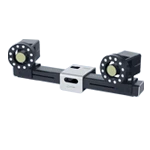
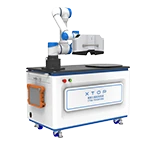
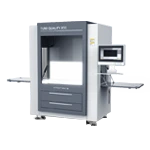
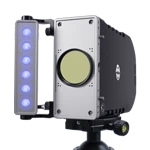
As a high-tech enterprise that independently developed 3D full-field strain measurement technology (DIC), XTOP3D showcased its XTDIC 3D strain measurement system at the event. The company’s booth was a standout attraction, drawing a steady stream of new and existing clients as well as industry professionals who engaged in technical discussions and inquired about the application of the equipment in seismic testing scenarios.

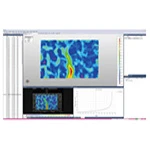
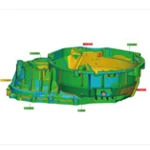
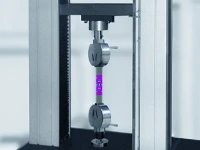
In discussions with experts, technical engineers from Xintuo 3D noted that traditional contact-based measurement methods have significant limitations for vibration simulation experiments; the attached equipment exerts a physical influence that compromises data accuracy. Furthermore, as the intensity of the simulated vibration waves increases, the model structure may sustain damage or even collapse, rendering attached measurement devices unable to capture critical parameters during the failure process. In contrast, DIC technology employs non-contact measurement to obtain full-field strain data across the field of view and measure point-to-point strain information, offering an effective approach for analyzing and studying the behavior of civil engineering materials and structures under impact loading.

Thanks to advantages such as a simple optical setup, strong environmental adaptability, a wide measurement range, and a high degree of automation, the XTDIC system has been widely adopted by renowned civil engineering schools and in practical engineering applications both domestically and internationally. In the assessment of civil engineering materials and structural seismic performance, its capabilities—specifically non-contact operation, high precision, and full-field measurement—effectively overcome the limitations of traditional deformation measurement methods, making it a highly notable measurement technique.
In the field of seismic engineering, the XTOP3D XTDIC system boasts a wealth of proven application cases. These include seismic simulations for super-high-rise buildings, wall seismic resistance testing, building vibration simulations, stress analysis of perforated walls in multi-story masonry structures, slope seismic vibration testing, scaled-model simulations using similar materials, and landslide experiments. Research utilizing DIC technology has yielded data and results demonstrating the system's excellent potential for seismic engineering research.
Application Cases in Seismic Engineering Experiments
Understanding the deformation characteristics of civil engineering structures under load is crucial for seismic design and safety. DIC strain measurement technology, capable of capturing the mechanical behavior of material and structural surfaces, serves as a vital research tool for evaluating the seismic performance of civil engineering structures.
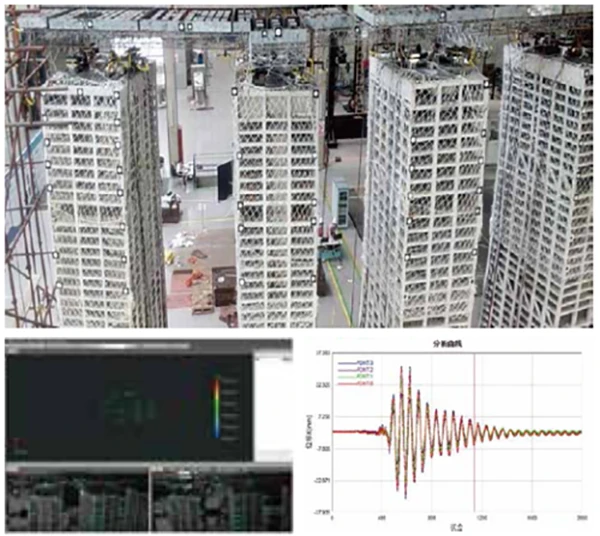
Seismic Simulation Experiments for Super-High-Rise Buildings
As modern buildings reach ever-greater heights and skyscrapers become increasingly common, simulating seismic effects to test failure mechanisms and seismic performance—particularly for the hybrid structural systems found in super-high-rise buildings—holds significant engineering research value. The XTDIC system enables full-field measurement of the failure processes in both concrete and steel structures, providing a clear, visual assessment of whether the building structure meets the required seismic performance standards.
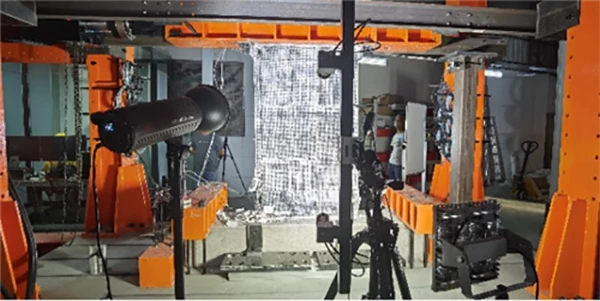
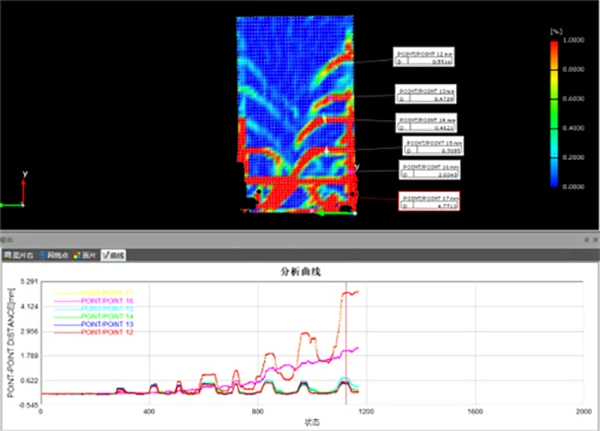
Seismic Testing of Structural Walls
The stiffness of a reinforced concrete structural wall reflects the structure's deformation capacity. When subjected to seismic action, the structure balances and resists the forces and effects of the earthquake through its own deformation. The XTDIC system enables the measurement of crack propagation and crack width in the specimen during simulated seismic loading; this allows for a more precise analysis of the relationship between structural performance objectives and seismic damage, providing data support for the seismic design of concrete materials and the validation of finite element analyses.
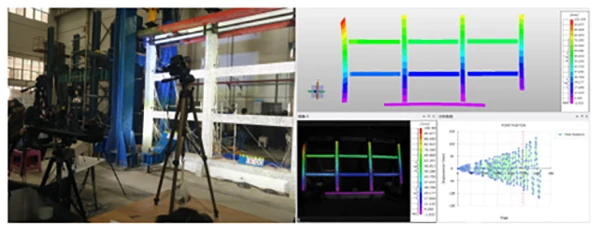
Seismic Simulation Test of Reinforced Concrete Frames
As concrete frame structures exhibit anisotropic material properties, predicting their failure characteristics under strong seismic action is often challenging; therefore, precise mechanical performance testing is crucial. The XTDIC system is suitable for displacement measurement in large-scale structures, enabling the study of deformation characteristics and collapse resistance of frame structures under strong earthquakes, thereby enhancing structural stability and improving seismic disaster prevention and mitigation capabilities.
Furthermore, in seismic performance testing applications within civil engineering, the XTOP3D XTDIC system captures full-field 3D dynamic displacement data, enabling accurate prediction of structural failure locations, critical failure points, and failure propagation paths. It is suitable for analyzing the seismic performance of building structure models, the load-bearing behavior of masonry walls with openings, and the impact of seismic events—such as slope instability and landslides—on the stability and serviceability of civil engineering structures.
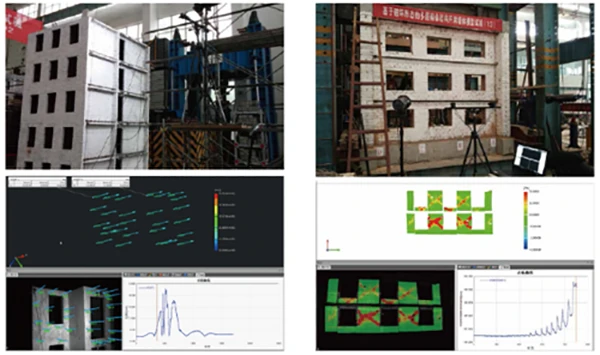
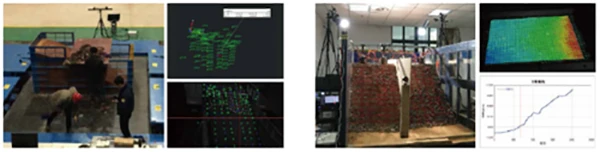
Structural dynamic model testing is a crucial means of investigating seismic damage patterns and an effective method for validating numerical analysis techniques. Obtaining the maximum amount of data is key to the success of building model vibration tests. The XTDIC system captures experimental data by monitoring targets during vibration tests; this not only significantly enhances the quantity and quality of the data obtained but also ensures a highly precise, complete record of the vibration process, thereby providing a high-quality data source for research into geological disaster prevention and structural seismic resilience.