I. Research Background
In deep-seam coal mining, high in-situ stress and intense mining-induced disturbances cause the overlying strata to undergo continuous movement, deformation, fracturing, and caving. This process results in a characteristic three-zone overburden structure: the caved zone, the fractured zone, and the bending-subsidence zone. The sudden instability of coal-rock composite structures can easily trigger dynamic disasters—such as rock bursts, coal and gas outbursts, roof collapses in roadways, and surface subsidence—thereby threatening the safety of mining operations.
Studying the full-field deformation evolution of coal-rock masses—from the initiation, propagation, and coalescence of fractures to ultimate structural instability—and obtaining continuous, high-precision quantitative data on displacement and strain, is essential for uncovering the underlying mechanisms of surrounding rock instability and developing early-warning models for dynamic mining disasters. Traditional monitoring methods are limited to localized, point-based observations and cannot provide comprehensive, full-process, or quantitative deformation monitoring. The XTOP3D XTDIC 3D strain measurement system, based on Digital Image Correlation (DIC) technology, effectively overcomes various measurement bottlenecks encountered in physical simulation experiments of coal-rock subsidence. It has now become a core testing instrument for both physical simulation studies and laboratory-based mechanical testing of coal and rock materials.
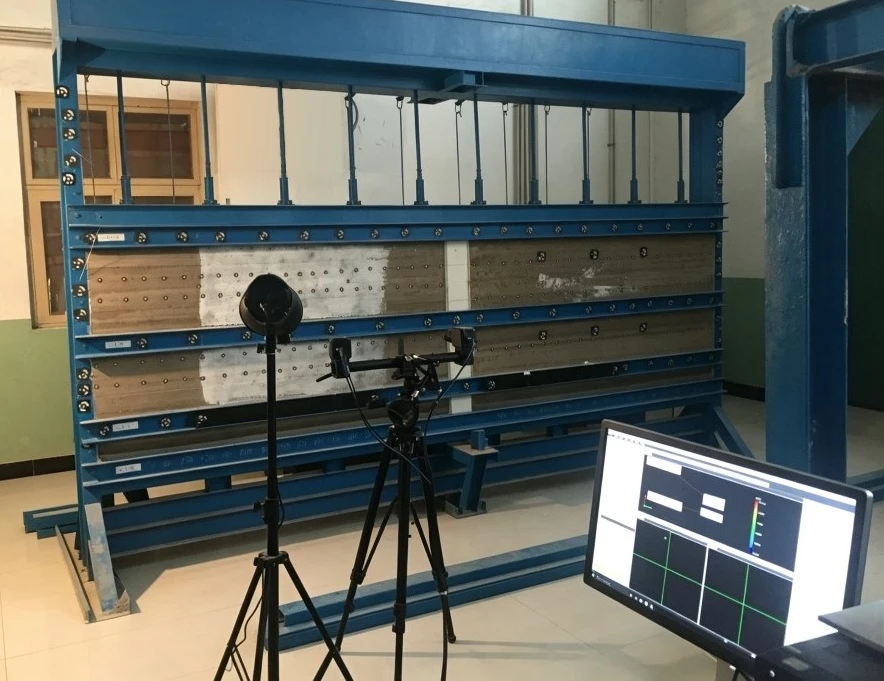
Simulation platform for fracture field development in overburden strata above a mining face, utilizing physical modeling with analogous materials and DIC (Digital Image Correlation) testing.
II. Comparison of Traditional Monitoring Methods and DIC Technology
Traditional monitoring methods are generally limited to localized, point-based observation and suffer from significant drawbacks: they cannot capture full-field deformation, require cumbersome equipment setup, introduce interference from the weight of sensors themselves, and are prone to missing micro-cracks. Furthermore, they struggle to provide continuous, precise, full-field strain data.
While traditional methods remain indispensable for localized monitoring and point-specific early warning, the failure and instability of coal and rock masses are, in fact, full-field evolutionary processes. Since the precise location of failure is often difficult to predict, localized monitoring points may fail to capture critical deformation data.
DIC technology does not serve as a complete replacement; rather, it acts as a necessary supplement and extension. By filling the gap in full-field deformation measurement, it complements traditional methods, collectively establishing a comprehensive system for monitoring the deformation of coal and rock.
III. Application Value of DIC Technology in Coal-Rock Subsidence Testing
(i) Current Pain Points in Physical Simulation Tests of Coal-Rock Subsidence
1. Fracture zones are stochastic, meaning fixed-point monitoring often fails to capture critical deformation data.
2. The evolution of coal-rock instability occurs over a long duration, making it difficult for conventional equipment to record data for the entire process.
3. Manual observation of fractures is prone to significant subjective error, and micro-fractures are difficult to quantify or analyze statistically.
4. Strain gradients at coal-rock interfaces are extremely subtle, rendering traditional equipment incapable of capturing the characteristics of interface instability.
(II) Core Advantages of 3D Full-Field DIC Measurement Technology
To address the aforementioned testing challenges, the XTOP3D XTDIC system provides a comprehensive non-contact, full-field measurement solution. It combines full-area coverage and high-speed transient capture with micron-level precision and the capability for multi-parameter quantitative analysis of fractures:
1. Non-contact measurement—imposing no additional load—is well-suited for large-scale physical simulation models, with high-speed cameras capable of capturing instantaneous, abrupt deformations.
2. Real-time output of displacement and strain contour maps; data from any time interval can be retrieved and reviewed, allowing for the rapid identification of high-deformation zones.
3. Automated detection of fracture initiation, propagation, and aperture, with quantitative fracture analysis performed using fractal dimension calculations.
4. Precise capture of minute strain gradients at interfaces, making it suitable for heterogeneous materials and simulation models undergoing large deformations.
IV. Case Studies on the Application of Physical Modeling (Similarity Simulation) in Engineering
Case 1: Similarity-Based Physical Modeling of Fracture Development in Overburden Strata During Mining
Research Background
Understanding the development and caving evolution of fractures in overburden strata during coal mining is crucial for assessing the stability of the surrounding rock mass. By utilizing physical models constructed from similar materials—in conjunction with Digital Image Correlation (DIC) technology—the dynamic deformation of the model surface was monitored throughout the excavation process. This approach allows for the reconstruction of the caving and fracture propagation processes within the overburden strata under mining-induced conditions.
Experimental Results
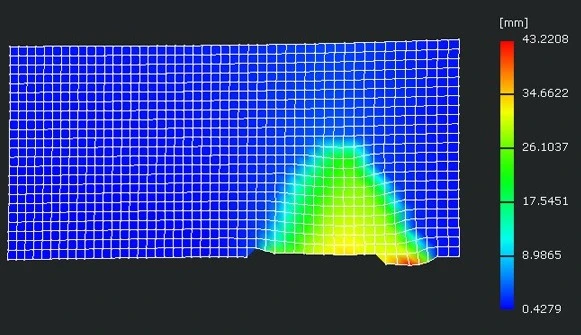
During the simulated step-by-step excavation, DIC technology was employed to calculate the full-field strain and displacement fields of the model. The strain at specific measurement points was observed to rise and then fall, reflecting an initial caving and fracturing in the lower section of the model, followed by subsequent caving and stress relief in the upper section. The displacement of the rock mass propagated progressively from the excavation side toward the opposite side. The deformation patterns derived from these measurements align closely with the manually recorded observations of caving and fracture development, successfully achieving a full-field characterization of the dynamic surface deformation of the physical model during the simulated mining process.
Physical simulation test platform for fracture field development in overlying strata
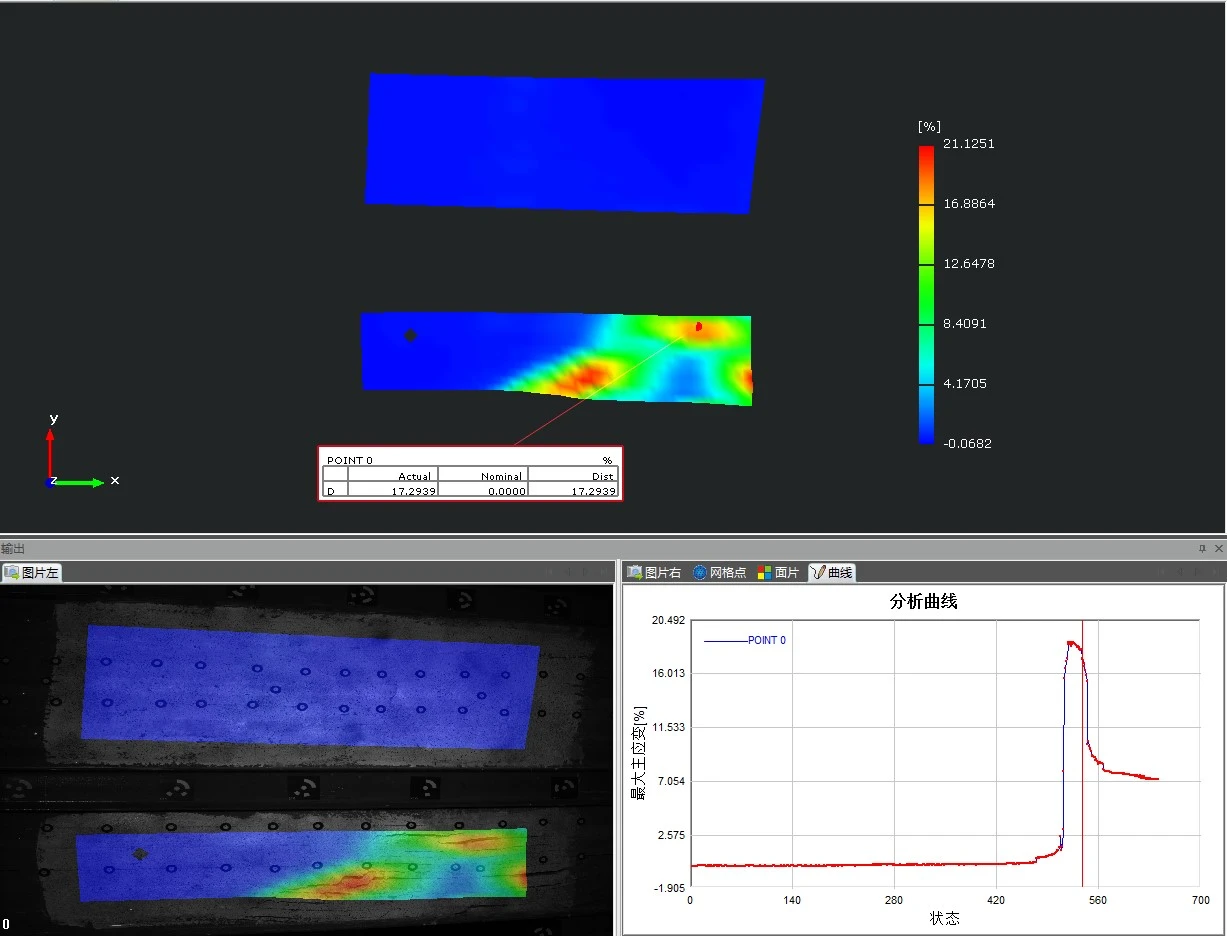
Strain field contour maps analyzed via DIC software
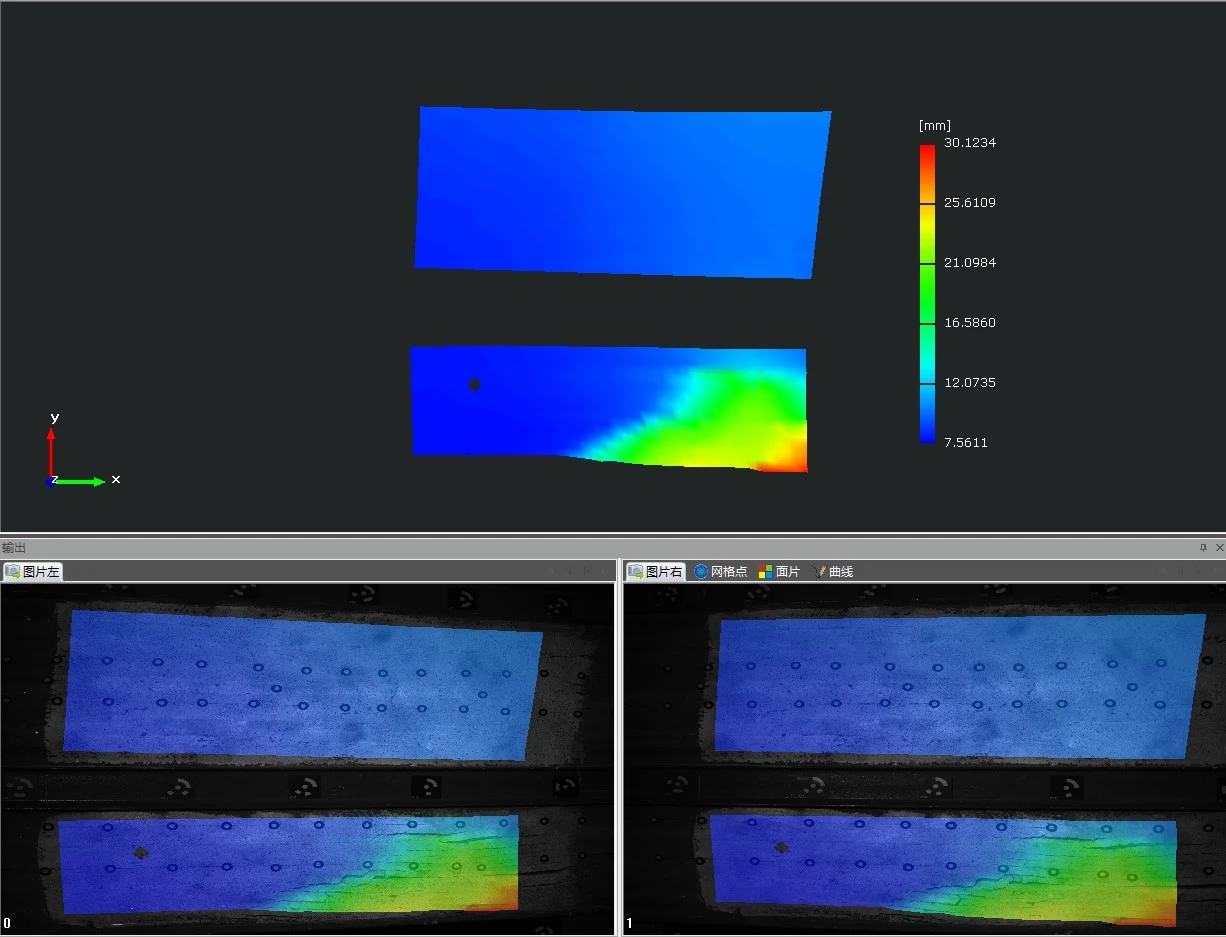
Analysis of displacement field contour plots using DIC software
Case 2: Physical Simulation of Fracture Evolution in Overburden Strata During Coal Seam Mining
Research Background
In the goaf (mined-out area), the development of overburden fractures is stochastic, and strain localization often occurs in a concealed manner. Traditional single-point monitoring methods struggle to fully characterize the spatiotemporal evolution of these fractures; furthermore, the placement of monitoring sensors compromises the integrity of the physical model and entails a heavy workload for data processing.
Experimental Results
The non-contact Digital Image Correlation (DIC) measurement technique preserves the original structure of the model while efficiently capturing deformation data across the entire field. By identifying abrupt changes in strain along specific measurement lines, the initiation points of fractures can be precisely located. The system simultaneously generates time-series contour maps and deformation curves for key points, providing a comprehensive visualization of the entire process—from the caving of overburden strata to the full propagation of fractures—and allowing for the clear delineation of the boundaries of the "three zones" (caved zone, fractured zone, and continuous deformation zone).
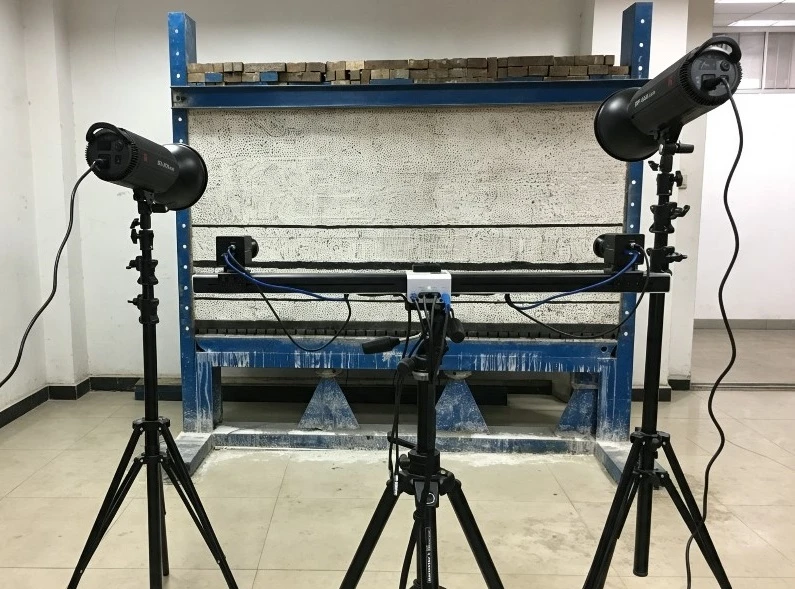
Test Rig for Overburden Fracture Simulation Models Using DIC Measurement
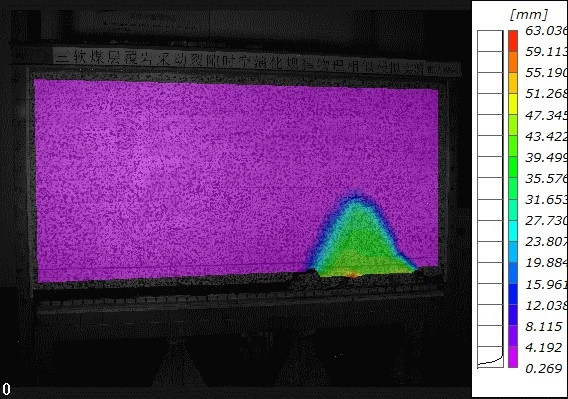
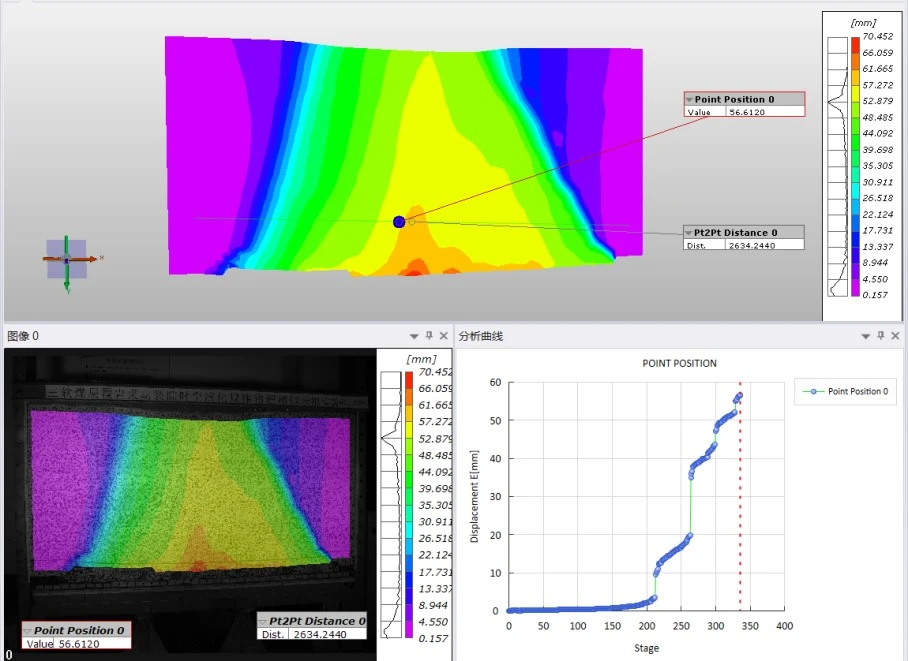
Analysis of Overburden Displacement Field Contour Maps Using DIC Software
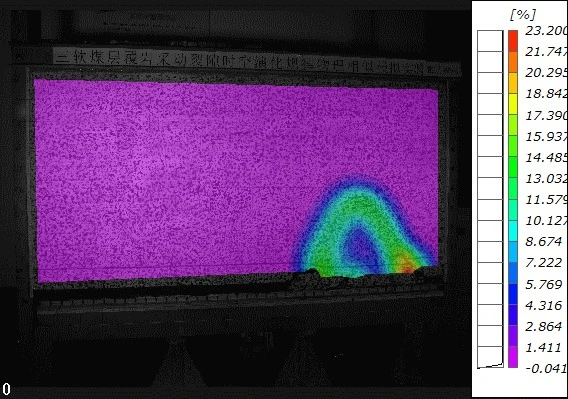
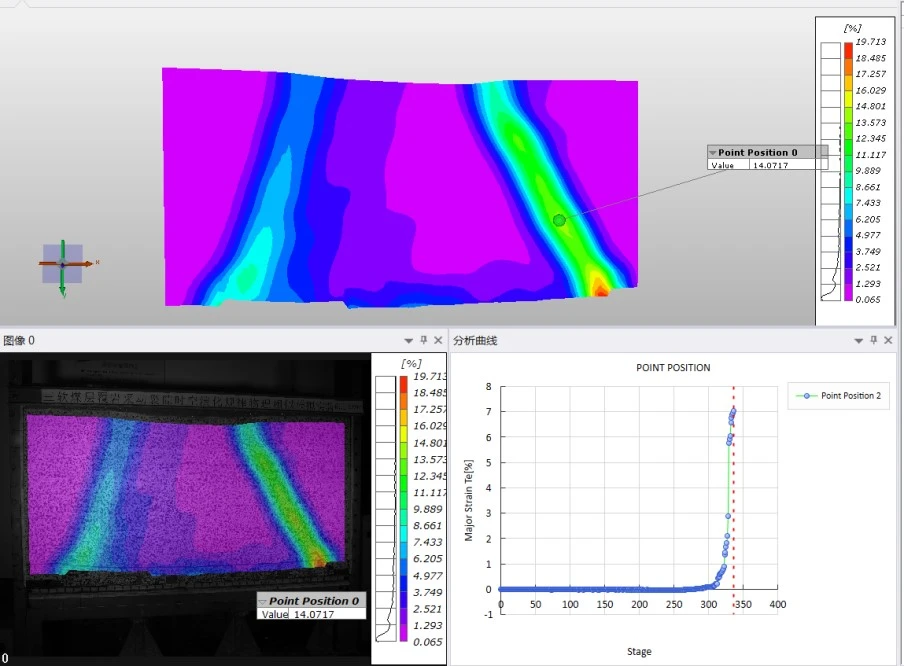
Analysis of Overburden Strain Field Contour Maps Using DIC Software
Case 3: Simulation Test on the Evolution of Mining-Induced Overburden Fractures in Extra-Thick Coal Seam Fully-Mechanized Top-Coal Caving (LTCC)
Research Background
In the goaf (mined-out area) of extra-thick coal seams, gas emission rates are high, posing a significant risk of gas accumulation in the upper corner of the working face. It is therefore necessary to quantify the vertical extent of overburden fracture development to determine the optimal horizon for high-level gas drainage boreholes.
Test Results
During the extraction process, 10 periodic weighting events occurred, with an average weighting interval of 23.6 m. The initial weighting took place after an advance of 110 m, and at an advance of 316 m, fractures extended upward to a maximum height of 140 m above the roof. The displacement contour map exhibited a trapezoidal expansion pattern, with peak strain values concentrated at both ends of the working face. The fractal dimension of the fractures showed a three-stage linear growth, with a goodness-of-fit (R²) greater than 0.92. The study identified the zone 10–70 m above the roof as a region of high-intensity bed-separation fracture development, providing direct guidance for the placement of gas drainage boreholes.
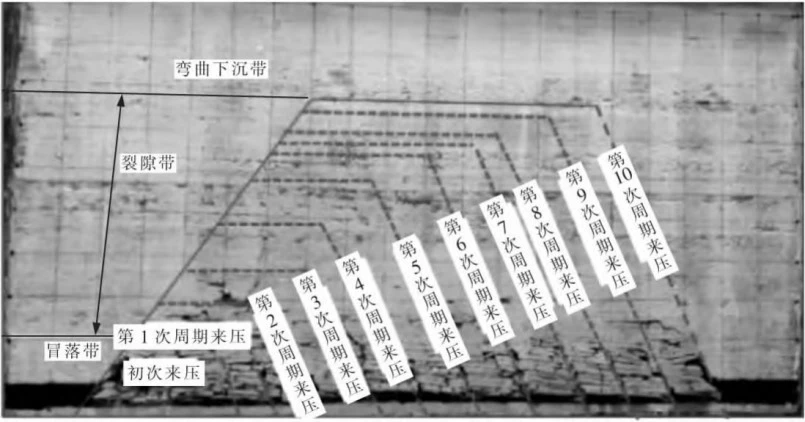
Caving patterns of the three zones in the overlying strata
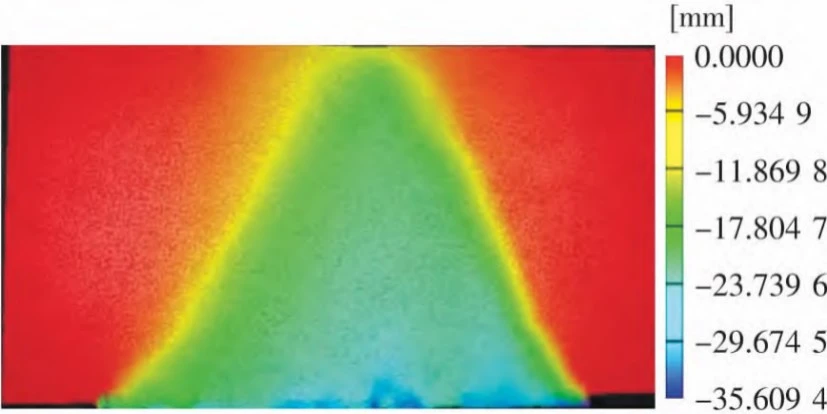
Cloud map of overburden deformation due to mining
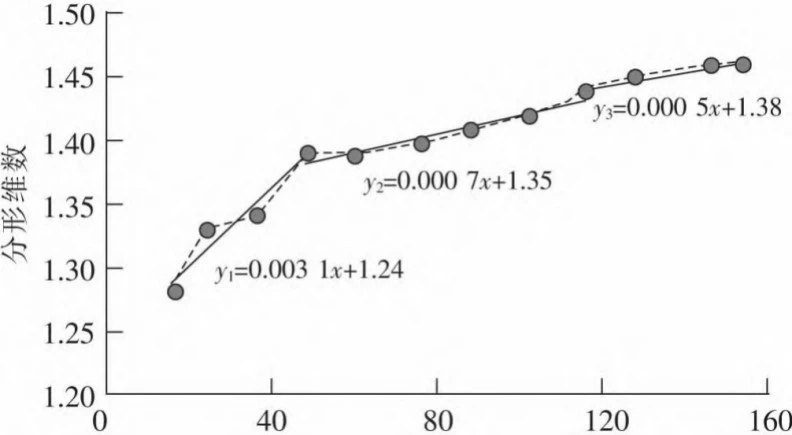
Fractal dimension fitting curve
Case Study 4: Simulation Test of Fracture Evolution in Overlying Strata of "Three-Soft" Coal Seams
Research Background
"Three-soft" coal seams—characterized by a soft roof, soft floor, and soft coal—exhibit low rock strength and severe fragmentation. The evolution of overlying strata caving is complex; traditional visual observation methods often fail to detect micro-fractures, making it difficult to quantify the fracture mechanisms in such soft rock environments.
Test Results
Digital Image Correlation (DIC) technology enables the comprehensive recording of the entire process of fracture initiation, propagation, and coalescence. This approach overcomes the limitations of traditional binarization-based observation, which often misses micro-fractures. By establishing a quantitative fracture observation method tailored to soft-rock models, this technique provides precise, detailed data to support roof control and gas management in soft-rock mining conditions.
V. Summary and Value of the Solution
The XTOP3D XTDIC 3D full-field strain measurement system, based on Digital Image Correlation (DIC) technology, provides a comprehensive, non-contact, full-field solution for measuring the subsidence of coal and rock. It serves as a complement to traditional point-based monitoring, enabling the construction of a multi-layered deformation monitoring system. Its core value is outlined below:
-
Full-field data synchronization and acquisition: Provides a comprehensive, full-field distribution of overburden displacement and strain in a single output, overcoming the fragmentation inherent in single-point monitoring data.
-
Full-process retrospective analysis: Captures the complete deformation cycle—from initial loading to structural instability—enabling the tracing of instability back to its source.
-
Quantitative characterization of fractures: Precisely identifies fracture development features and utilizes fractal dimensions for quantitative statistical analysis.
-
Uncovering mining-induced mechanisms: Employs multidimensional, quantitative data to elucidate the spatiotemporal evolution of overburden subsidence and fracture development.
-
Supporting disaster prevention and control: Provides an experimental, quantitative basis for gas drainage, roadway support, and early warning systems for rockbursts and surface subsidence.








 Video Center