Latest Events

XTOP3D releases the latest news and information, providing you with first-hand information about the company.
3D DIC, digital image correlation, pipeline strain measurement, full-field strain analysis, large-scale deformation testing, structural health monitoring, non-contact strain measurement, oil pipeline safety, XTDIC system, material mechanics testing,

3D DIC Full-Field Strain Measurement for Large-Scale Oil Pipeline Deformation Testing

Date:2025-04-16
The XTOP3D large-scale speckle strain measurement system is used for monitoring oil pipelines. my country’s oil and gas pipeline network has expanded rapidly and covers a vast area, yet the associated risks are also rising. Various adverse conditions—such as fault displacement, slope instability, the collapse of collapsible loess, frost heaving, and thaw settlement—can cause significant displacement and deformation in buried pipelines, thereby compromising their safe operation. Given that petroleum is highly flammable, explosive, and a potential source of environmental pollution, the safety of its pipeline transportation is of critical importance.

Petroleum is a vital raw material for both industry and daily life; countless everyday products are derived from it. Beyond the fuels that power vehicles such as cars, airplanes, and ships, petroleum-based products are ubiquitous in our daily lives.

For instance, colorful plastic goods, asphalt for road paving, synthetic fabrics like polyester, acrylic, and nylon, the synthetic rubber used in footwear, as well as certain pharmaceuticals, cosmetics, shampoos, and body washes, all rely on petroleum and its derivatives for their production. It is no exaggeration to say that we live surrounded by products derived from petroleum.
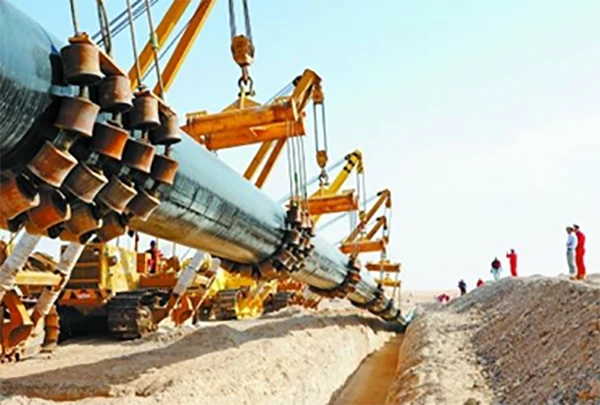


Large-Area Speckle Strain Measurement System — Strain and Deformation Measurement for Large-Scale Oil Pipelines

Traditional stress-based pipeline design methods primarily aim to ensure that pipeline stresses—or equivalent stresses—resulting from external loads do not exceed the material's allowable stress. However, for pipelines subjected to displacement-controlled loads (such as those caused by earthquakes, ground subsidence, landslides, or subsea pipeline laying operations), stresses often exceed the yield limit; consequently, stress-based design methods are no longer applicable, and strain-based design approaches are more appropriate.


A technical research institute plans to utilize the XTDIC 3D full-field strain measurement and analysis system (from XTOP3D) to investigate the strain deformation of large-scale oil pipes under compressive loads through compression tests, thereby analyzing the mechanical properties of the engineering materials used in the pipes.
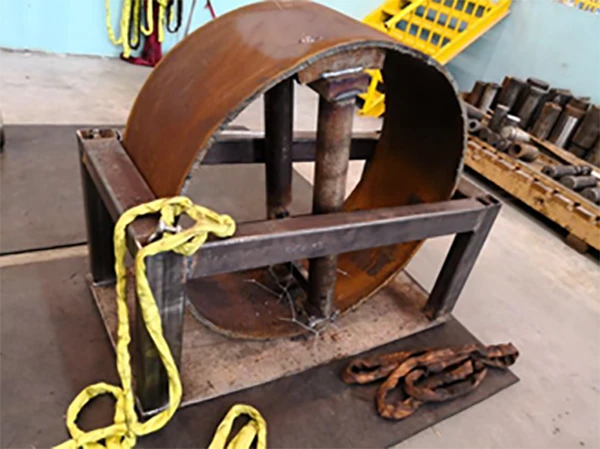

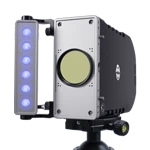
In this experiment, a large-scale oil pipe section is first placed inside the testing machine, and a pressing head applies load to observe the deformation of the inner surface under stress. The inner surface is then ground and sandblasted, and the probe and light source are secured within the pipe's interior, as shown in the figure.
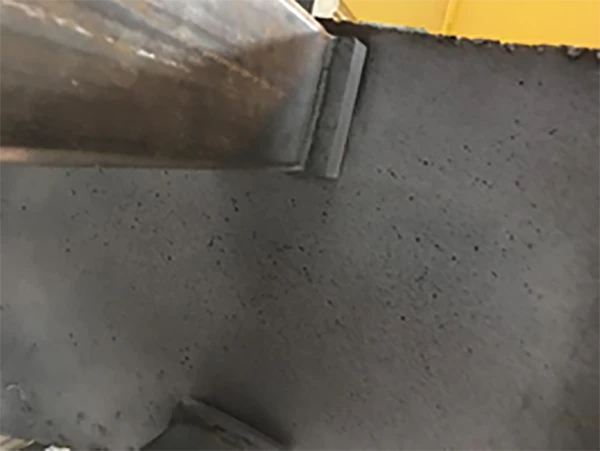
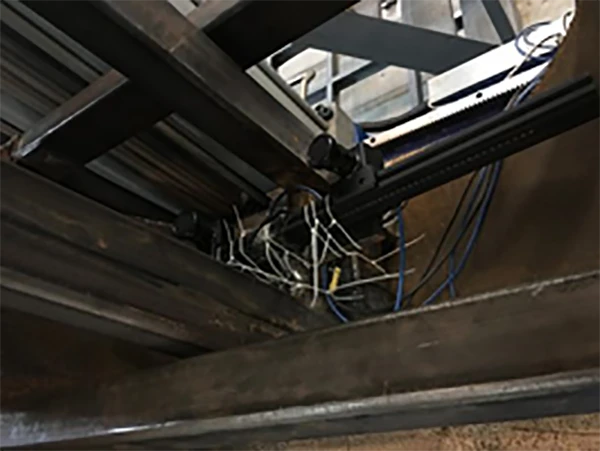

Suspend the pipe section—complete with the measuring probe—beneath the loading head to enable continuous monitoring of strain and deformation on the inner surface throughout the combined large-deformation test conducted on the pipe.
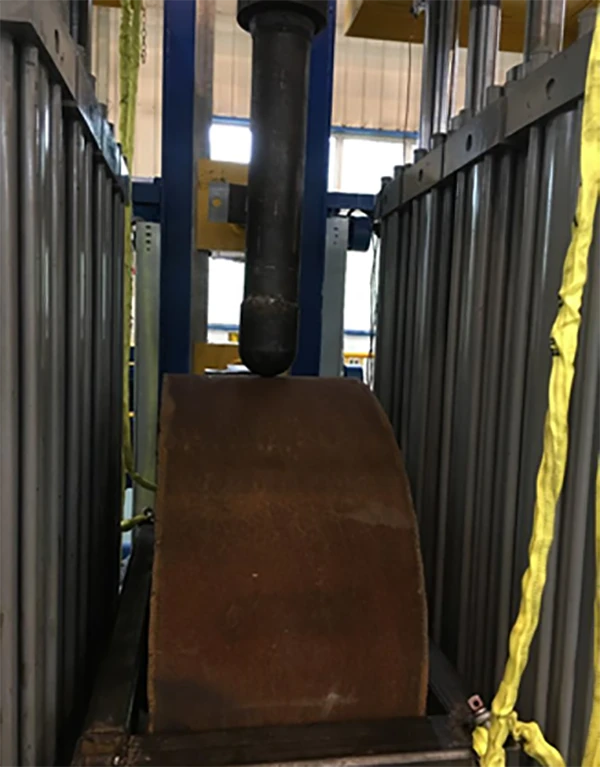


When the testing machine begins operation, the XTDIC system performs synchronous data acquisition until the loading process concludes and image capture is complete. Calculations are then performed using the XTDIC system's analysis software, enabling the analysis of displacement and strain field data for the oil pipeline based on the results.
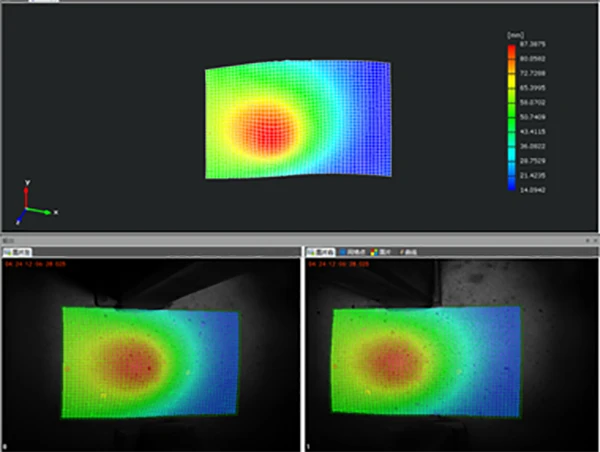
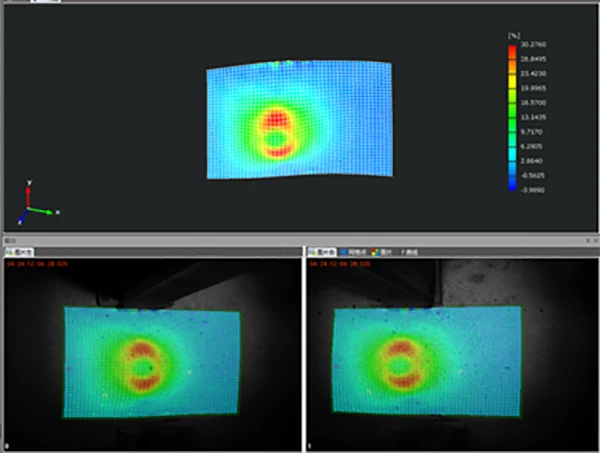
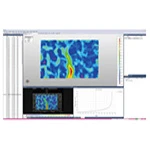
This experiment simulated the loading conditions experienced by oil transmission pipes during service. XTOP3D’s XTDIC system and analysis software were employed to capture images and calculate full-field displacement and strain data in real time, with results output in the form of charts and curves.

The experiment successfully achieved full-field strain measurement of the pipe specimens. The experimental data aligned closely with finite element analysis results, providing critical technical parameters for strain-based design in oil pipelines and helping to further enhance the safety of pipe design as well as the operational safety and reliability of the pipeline.


Recommended Information

  • At the China Materials Conference 2026 in Wuhan, XTOP 3D showcased its self-developed XTDIC series of 3D full-field strain measurement products. Addressing the limitations of traditional single-point mechanical testing, the non-contact optical DIC solutions provide high-precision, non-destructive evaluation across diverse conditions—including quasi-static, high-temperature coupling, cyclic fatigue, and high-speed impact—to accelerate new material R&D and reliability verification.
    2026-07-17
  • XTOP3D made a significant appearance at the China-Europe Symposium on Biomaterials (CESB 2026), showcasing its XTDIC 3D full-field strain measurement system and XTOM high-precision 3D scanner to empower innovation in biomaterials and medical devices. Leveraging a portfolio of 3D optical measurement solutions, the company supports a wide range of applications—including mechanical property testing for biomaterials, digital dentistry, high-precision dimensional inspection of implants, and comprehensive testing for deformation, posture, and fatigue—thereby safeguarding product quality across the industry through professional technology.
    2026-07-10
  • XTOP3D participated in the 3rd Symposium on Mechanical Testing Methods and Technologies for Micro-specimens, showcasing its 3D microscopic strain measurement system and demonstrating its applications in areas such as mechanical property testing of materials at the mesoscale, as well as thermal (warpage and CTE measurement) and mechanical deformation analysis of semiconductor devices.
    2026-03-25
  • XTOP3D showcased its XTDIC 3D full-field strain measurement system at the China Materials Conference 2025, demonstrating the system's application in mechanical testing for new material R&D. The system supports a wide range of tests—including tension, compression, bending, torsion, and shear—and accommodates static, quasi-static, and dynamic strain, vibration, and high-speed deformation measurements, as well as testing in extreme high- and low-temperature environments. It also features connectivity modules for various testing machines to meet diverse experimental requirements.
    2026-03-25
  • XTOP3D has been invited to exhibit at the Chinese Congress of Theoretical and Applied Mechanics 2025, where it will showcase the XTDIC 3D full-field strain measurement system and its applications in areas such as static load testing, dynamic fatigue testing, and 3D deformation and strain measurement. DIC technology provides researchers with reliable experimental data for studying the mechanical properties of various materials and structures.
    2026-03-25
  • This article highlights the application of XTOP3D’s XTDIC-SPARK 3D high-speed measurement system in explosion mechanics and high-strain-rate impact testing. It focuses on three typical application scenarios: Analysis of transient deformation and displacement curves during high-speed armor-piercing projectile impact; Full-field strain monitoring with high spatiotemporal resolution during Hopkinson Bar impact tests; Quantitative analysis of transient crack evolution and propagation behavior in materials during high-speed compression tests. Key technical breakthroughs include achieving sub-pixel measurement accuracy under conditions of ultra-high speeds, short time windows, and severe deformation, as well as overcoming challenges related to the acquisition of specialized speckle patterns.
    2026-03-25