Client Requirements
Studying the rock mass mechanics associated with excavation activities is a crucial step in mining engineering. Such research guides mine construction and production, helps prevent or eliminate hazards to safety and operations caused by ground pressure and landslides, improves blasting designs, and informs the selection of rock fragmentation methods and the understanding of natural ore body caving patterns.
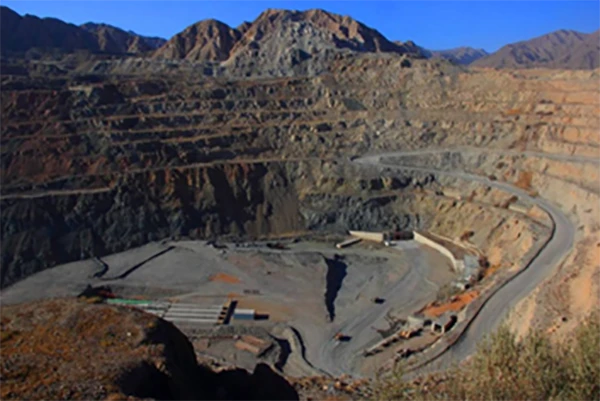
The subject of mine rock mechanics research is the natural rock mass—a geological formation typically intersected by discontinuities and characterized by anisotropy and heterogeneity. The mechanical behavior of such rock is complex, particularly when fractures and pores contain water or gas. To investigate the mechanisms of rock failure, a mining research laboratory at a prominent Chinese university conducted high-speed compression tests to analyze the strength and deformation characteristics of rock specimens, thereby providing data to support a deeper understanding of rock mechanical properties.
Testing Challenges
Mineral deposits are often situated in harsh geological environments, necessitating consideration of the various stresses acting upon the rock.
First, the significant depth of mining operations requires accounting for the self-weight stress of the rock mass, as well as the immense near-horizontal tectonic stresses acting on the deposit.
Second, rock mechanics issues persist throughout the entire mining process; given the frequent use of blasting in production, the dynamic effects of such blasts must be taken into account.
Finally, the limited service life of a mine imposes a tight schedule, requiring a condensed research timeframe.
Traditional high-speed rock compression tests rely on strain gauges for measurement. While strain gauges offer high sensitivity and precision, they are limited to point measurements of strain in a fixed direction and cannot provide full-field measurement.
Consequently, strain gauges are unsuitable for tasks involving large-scale deformation or fracturing, or for measurements across extensive engineering surfaces, as they fail to accurately capture the regions of maximum strain.
3D Optical Measurement Solution
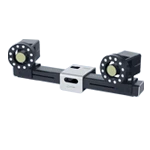
The XTOP3D XTDIC 3D optical strain measurement system not only meets the requirements of standard rock compression tests—capturing full-field strain and displacement data—but also enables comprehensive analysis for scenarios such as small specimens and high-strain conditions, including full-field strain mapping and crack propagation tracking. This significantly expands the capabilities available for rock compression testing.
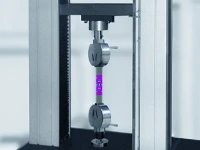
The university laboratory employs a similar-material simulation method, using materials that mimic the properties of actual rock. Tests are conducted using a high-speed compression testing machine, with the XTOP3D XTDIC system utilized for image acquisition and data analysis to examine the mechanical phenomena and processes occurring in the prototype rock during compression.
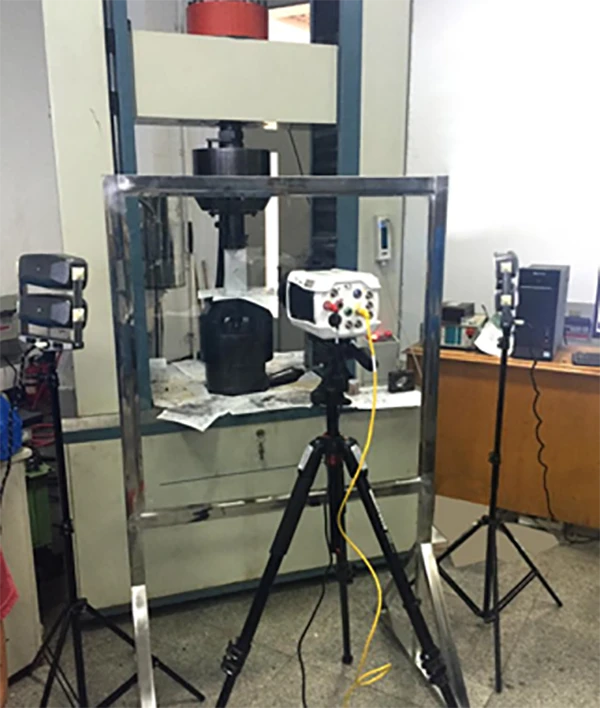
The test was conducted on a rigid compression testing machine controlled by both axial and lateral displacement rates; the axial displacement loading rate was set to subject the rock specimen to high-speed loading.
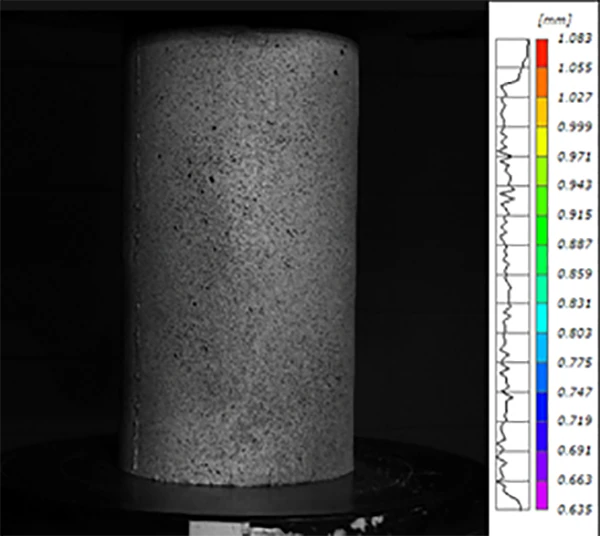
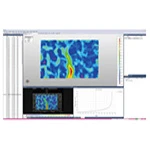
During the test, the XTOP3D XTDIC system performed synchronous image acquisition; the analysis software converted the images into corresponding stress and strain data and transmitted them to the system terminal, ensuring data integrity and accuracy.
Data Analysis
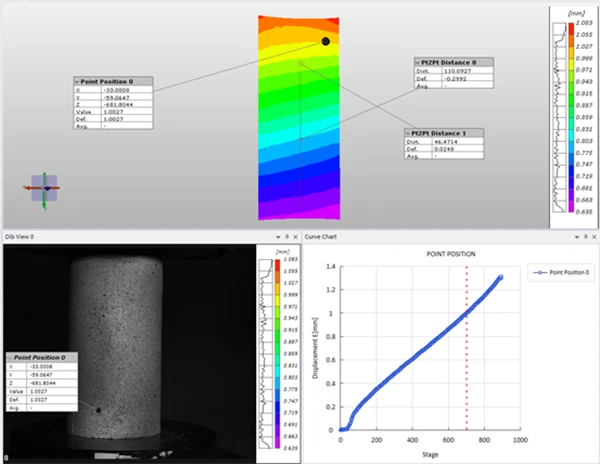
Based on the loading results for the rock samples, the uniaxial stress-strain curves were plotted and analyzed. The results indicate that the rock deformation decreased from top to bottom under the axial load applied by the testing machine, and that a linear relationship existed between the axial load and the amount of deformation.
Value of the Solution
By utilizing the XTOP3D XTDIC system in high-speed rock compression tests, the university's mining research laboratory can capture rock deformation characteristics and stress-strain curves. This enables the study of key mechanical properties—such as compressive strength, Young's modulus, and Poisson's ratio—under various conditions involving moisture content, granularity, bedding planes, and fractures.
The development of mine rock mechanics is closely linked to mining engineering. Research in this field is of great significance for addressing issues such as ground pressure control in mine roadways and stopes; the mechanisms and prevention of rockbursts; deformations in roadways and at the surface caused by safety pillars; and stability and reinforcement measures for high slopes in deep open-pit mines. Such research holds immense practical value for preventing the loss of national resources.